|
Texas
| History
ALAMO LETTER
From Travis'
hand
to the State Archives
or
Is there a Graphologist in the House?
by John
Troesser |
|
|
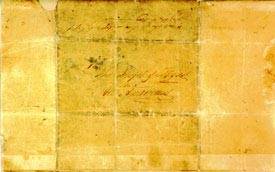
Cover
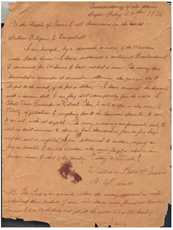
page of the Travis Letter
Image courtesy Texas State Library & Archives Commission |
The
dispatch from what we now call the Alamo
was initially carried by Captain Albert Martin of Gonzales.
En route to Gonzales
with the letter, Martin heard the battle underway and felt compelled
to add his own message to the dispatch. When he arrived in Gonzales,
Martin passed the dispatch to Lancelot Smither, who later added his
own note - both of which can be read on the copies displayed on the
TSL website.
The TSL website states: "There is evidence that Smither extracted
the essence of the letter and deposited this copy with Judge Andrew
Ponton before he departed Gonzales.
Ponton prepared other copies and forwarded these to Nacogdoches
and other population centers in the province."
Smither carried the letter on to San
Felipe. Slowed by a bitter storm, it took him 40 hours to cover
approximately 90 miles. "A reasonably accurate printing" of Travis'
message was made at San
Felipe. Two hundred copies were initially printed and eventually
it went into five printings - but none were printed verbatim. Subsequent
printings over the years seem to have been drawn from what had been
printed in San
Felipe. It is believed that the original document was given to
the Travis family after the war. |
|
|
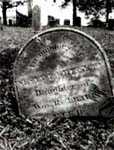
Vandalized
Tombstone of William Travis' daughter Susan Grissett in Chappell
Hill Masonic
Cemetery. (It has since been mended.)
Photo circa 1960. Courtesy Texas State Library & Archives Commission |
The
letter went from Travis' daughter, Susan Isabella Travis (who was
only four years old when her father died) to her daughter and then
on down until it reached a great grandson who, in the 1890s, found
himself "financially embarrassed." The grandson offered
to sell the letter to the State in 1893 for $250. History wasn't a
priority at the time and that sum was considered a heavy expenditure.
The grandson demonstrated his patriotism by offering to sell it to
the state below any private bids - to insure preservation of the document.
It was eventually acquired for $85.00 and the Texas State Library
and Historical Commission (as it was then called) became custodians
of the letter on March 19, 1909.
Source:
www.tsl.state.tx.us/treasures/republic/alamo/travis-01.html
|
|
|
|
|
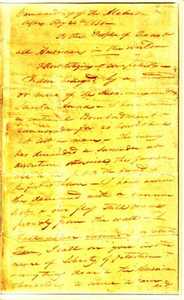
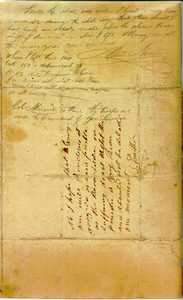
L -State Archive's
Travis Letter Page 2
R - Travis Letter showing the writing of Martin and Smither
Images courtesy Texas State Library & Archives Commission
|
|
|
The
"Bonham" Alamo Letter
Click on photo for larger image
Photo courtesy David London and Patricia A. Roulette |
|
New
Letter from the Alamo
(The unpublished letter - never seen by the public - that sat for
years in the bedroom of "Aunt Cora" - so that it wouldn't
embarrass the State of Texas.
Shared with the readers of Texas Escapes by David London, Bonham,
Texas, July 30, 2005 )
It is entirely possible that this new letter from Bonham
is one of the copies made by Judge Ponton in Gonzales.
Nevertheless, even as a copy, it remains an important artifact of
the Texas Revolution. However, the question about the spelling of
Travis' middle name is still a mystery. It would seem that there
would be enough samples of Judge Ponton's handwriting extant to
compare his style with whoever penned the "Bonham" letter.
|
A
few other remaining artifacts from the Texas Revolution
Since the spoils of war belong to the victors, artifacts such as Bowie's
original knife - or Crockett's famous musket "Old Betsy" found themselves
(at least temporarily) in the hands of the troops that besieged the
Alamo. How many "original"
Bowie knives have been passed off onto tourists in Mexico as the real
item - will never be known. "Old Betsy"on the other hand has supposedly
surfaced - but that's a story we don't currently have any information
on. The
cannon that fired the first shot of the war near Gonzales disappeared
for a hundred years and was then unearthed by a flood almost exactly
100 years later. It resides today in Gonzales
- a tiny thing considering the colossal changes it brought about.
One other authentic relic is on display daily. It's the flag that
flew above the Alamo
during the seige. It hangs today behind a bulletproof glass case at
Chapultepec Castle in Mexico City - guarded 24 hours a day by armed
sentries. When Texas was having it's sesquicentennial in 1986 - Texas
asked the Mexican government if the flag might be loaned out for the
festivities. The answer - accompanied with a big smile - was the Spanish
equivilent of "We don't think so." Some people have long memories.
From San
Jacinto - spoils included Santa
Anna's gold-buttoned embroidered vest that was worn by bridesgrooms
in Fayette County
until it finally disappeared in the 1930s.The dictator's wash basin
and pitcher found their way to Bastrop
County where a tiny blurb in the Bastrop Adverstiser in
the 1930s mentioned that it was thrown and smashed during what is
now known as a "domestic disturbance."
© John Troesser
August 11, 2005
Any constructive or informative letters are invited.
Contact history@texasescapes.com
|
|
|
 HOME
HOME