|
|
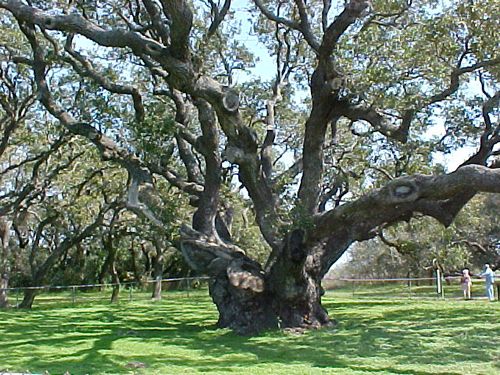
The Big Tree
AKA The Goose Island Oak
Photo courtesy Ken
Rudine, 2006 |
| Record or Champion
Trees are determined by their girth, their spread and their height.
There are many Live Oaks that surpass this tree's height, however
when the tree's girth is factored in, it makes this one the Champion
Live Oak in Texas. |
by John
Troesser
Texas'
largest tree is found on the Lamar Peninsula within the Goose
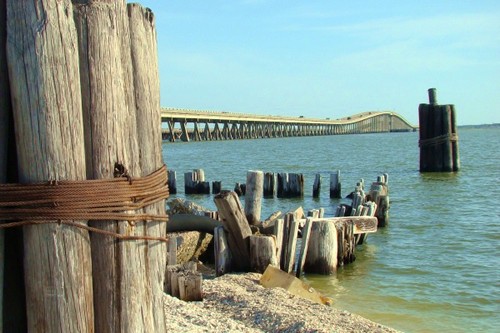
Island State Park just off highway 35 before you reach the Copano
Causeway (if you’re coming from the north). Signage will direct you,
but the signs are close to the ground and infrequent.
The tree has allegedly been a hanging tree, a pirate's rendezvous,
and even a ceremonial site for the cannibalistic Karankawa Indians.
|
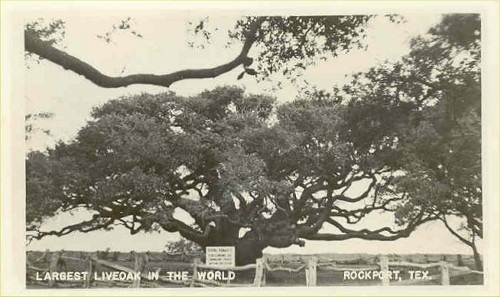
"Largest
Liveoak of the World, Rockport,
Texas."
Postcard courtesy www.rootsweb.com/ %7Etxpstcrd/ |
The
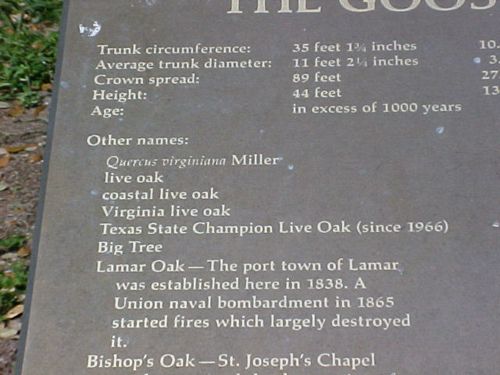
Big Tree / Goose Island Oak plaque
Photo courtesy David Armstrong |
The
tree has disappointed generations of Texans who often feel that their
Live Oak back home is bigger – or at least taller. They may be right.
Determining a record tree involves three measurements: the spread
of the crown, the circumference and the height. An overall score is
reached by these factors, and according to the experts – this one
is the winner.
In the case of the Goose Island Oak, the factor least argued about
is the tree’s massive girth. According to the book Famous Trees of
Texas, the tree’s circumference was recorded at 42 3/4 feet in 1966.
The crown was 44 feet high and the spread was 89 feet.
The tree is naturally linked to anyone remotely connected to the coast
– from a meeting place of the rude Karankawas to Cabeza
de Vaca and LaSalle.
The estimated age of the tree is 1,000 years old. Although a core
sample has not been taken, it shouldn’t be too long until technology
allows for a reliable determination of the tree’s age. |
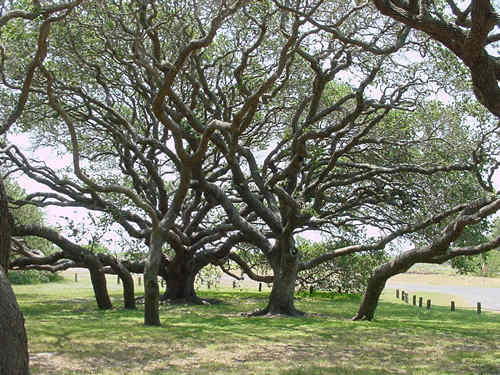 |
The seldom written
about neighboring trees of the Goose Island Oak
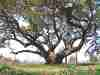
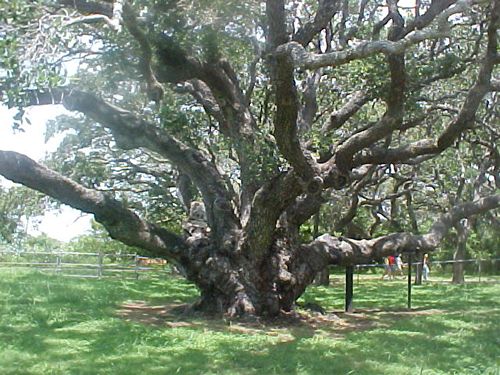
The trees immediately to the right (East) of the Big Tree
TE Photo, August 2003 |
| While the tree
has had its immediate neighbor’s thinned-out over the years, enough
of the trees younger cousins have survived to give an idea of how
the mott appeared in the past. The unusual branching pattern is a
result of the near-continuous gulf breeze. |
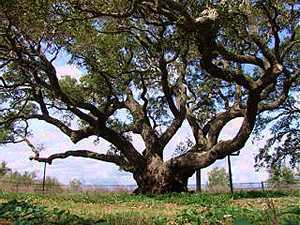
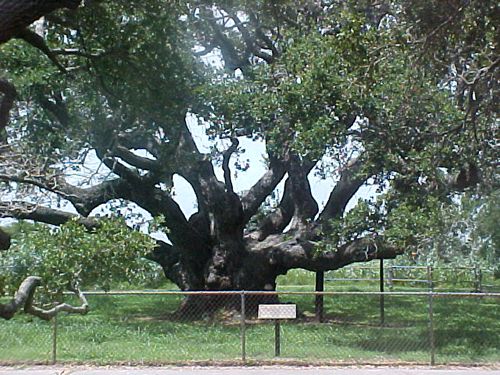
The Goose
Island Oak
TE Photo, August 2003 |
Estimated
to be 1,000 years old, the tree can disappoint visitors who had been
imagining a Giant Sequoia.
Our tip for visitors who don't want to be disappointed: Don't
visualize Giant Sequoias. |
The
Big Tree
Photographer's Note
"I first saw the tree in the early 1960's while on one of many
fishing trips to the coast. While living in Aransas
Pass in the 1990's I took my children there many times and it
never failed to impress me no matter how many times I saw it. Thinking
of the history that tree must have seen and the hurricanes it survived
gives you an appreciation of how sturdy and tough those old Live Oaks
are." - David Armstrong, June 09, 2011 |
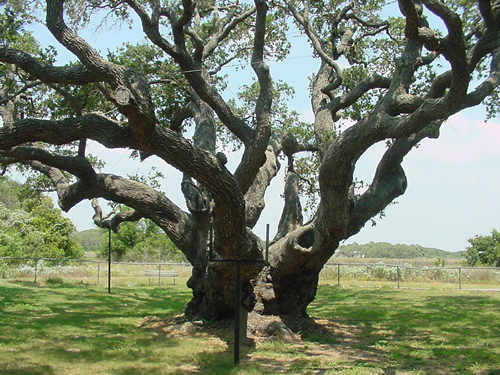
The
Big Tree
Photo courtesy David Armstrong |
The
Big Tree
Photo courtesy David Armstrong |
The
Big Tree
Photo courtesy David Armstrong |
The
Big Tree
Photo courtesy David Armstrong |
The
Goose Island State Park allows an opportunity
for observing the migratory whooping cranes and deer abound in the
thickets.
Area Destinations
While visiting the tree, you might consider visiting the picturesque
Lamar Cemetery
- shown on detailed TxDoT maps. Lamar
was a town named after the Republic of Texas' second President that
held great promise in the 1830s. Lamar
is included in More Ghost Towns of Texas by T. Lindsey Baker, University
of Oklahoma Press, 2003.
Texas' second largest Live Oak
is in Columbus,
Texas. |
Directions
to The Big Tree
Leaving Fulton,
heading N and crossing over the Copano
Bay bridge, the first right will be Park Road 13. This will connect
with Lamar Beach Road that can take you to the tree. Signage is adequate
for finding your way there after leaving Highway 35, and depending
on the time of day or the season, you may encounter deer on the narrow,
densely shaded and flowered road. |
|
Texas
Escapes, in its purpose to preserve historic, endangered and
vanishing Texas, asks that anyone wishing to share their local history,
stories, and vintage/historic photos, please contact
us.
|
|
|
 HOME
HOME