|
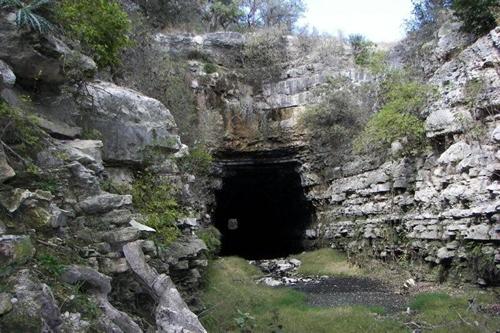
The Fredericksburg
and Northern Railway tunnel today.
Photo
courtesy Terry
Jeanson, November 2007 |
Though
the Galveston, Harrisburg, & San Antonio Railroad built its last 23.5+
miles from Marion to San
Antonio in 1877, the International & Great Northern completed
its Austin Laredo line in 1881, passing through San
Antonio, and the San Antonio & Aransas Pass completed its line
from the Alamo City
to the coast in 1886, the area to the north and west of San
Antonio was without rail connection to the great hub of south
Texas for several years. Prior to the War Between the States, it could
take as much as ten days for wagon freight to reach such remote outposts
as Fredericksburg
or Kerrville
from San Antonio and
that was "barring mishap" (Indians). Even after the War, with much
improved roads and a much lessened Indian problem, it still took freight
wagons the better part of a week to travel from San
Antonio to Fredericksburg.
The San Antonio Fredericksburg stagecoach took two days-"barring mishap"
(in this case, bandits) and there were few runs in which a "mishap"
did not occur. The people north and west of San
Antonio wanted and needed a railroad.
Unlike today, when railroads are being consolidated and tracks are
being abandoned almost on a daily basis, from the 1870s until the
1940s railroads were the transportation lifeblood of the nation, both
for passengers and freight. For a town to be missed by the rails was
a death sentence. The list
of towns, in Texas and elsewhere, that died because they had no
railroad would fill a sizable book.
As early as 1880 a preliminary survey was made to find the most practicable
rail line from San Antonio
into the hill country to the northwest, and it was quickly discovered
that there was a smooth, easy route to Kerrville
but a very rough one to Fredericksburg.
When the San Antonio & Aransas Pass announced, in 1886, that it would
build a hill country branch, both Kerrville
and Fredericksburg
put in bids and Kerrville,
having the triple advantages of easy grades, no high hills to cross,
and Charles Schreiner; founder of the great YO ranch, on the railroad
acquisition committee, won. The rails were laid into Comfort
and then made an abrupt bend to the northwest. The first train rolled
into Kerrville
on October 6, 1887.
This disappointed not to say infuriated the good burghers of Fredericksburg.
They sent a delegation to the San Antonio office of Uriah Lott, president
of the SA&AP, to demand an explanation. Lott explained that the much
rougher country from Comfort
to Fredericksburg
and the current financial condition of the SA&AP did not make it possible
to build to Fredericksburg.
|
|
|
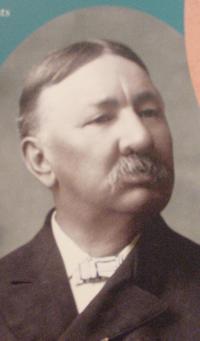
Uriah Lott
Photo courtesy The Kenedy Museum, Sarita, Texas
|
In
1886 Temple D. Smith, a Virginian and a banker by profession, came
to Fredericksburg
and organized the Bank of Fredericksburg. He immediately decided that
the town needed, above all else, a railroad and he would devote most
of the rest of his life to getting it one.
The first stab came in 1889 when a Llano lawyer, W. A. H. Miller,
proposed to Smith and others in Fredericksburg that the towns of Fredericksburg
and Llano,
with the help of San Antonio, jointly finance the building of a grade
from Comfortto
Llano
via Fredericksburg.
The SA&AP would then lay track over the line and operate it as a branch.
Fredericksburg actually financed and built 17 miles of graded roadbed
going south, but it stopped at "the big hill" the range of hills that
forms a sort of divide about one third of the way from Comfort
to Fredericksburg,
just north of the ghost town of Hillingdon. This divide is between
the Guadalupe
and Pedernales
rivers. There simply was not enough money to complete the project,
and it was dropped after $85,000 had been spent. (Pronounce that 'perd'n'alice'
and you'll be understood in the Hill Country. Texans had a lot of
fun out of Yankee newsmen trying to pronounce 'Pedernales' during
the Lyndon Johnson presidency.)
The Fort Worth & Rio Grande, when it reached Brownwood
in 1891, announced its intention to extend the line on to Brady
and Menard
and to add a southward branch to Fredericksburg.
This raised hopes in the German city, but except for a little over
a mile and a half of connecting track the FW&RG laid in Fort
Worth itself in 1891--the company didn't build another mile of
track until 1903, when it finally built into Brady.
It would not reach Menard
until 1911, at which point building farther south was a moot point.
In June of 1909 J. P. Nelson, a former director of the SA&AP, proposed
to build the line from Comfort
to Fredericksburg,
using the 17 miles of grade previously completed. Though he did begin
energetically, by the end of September he'd run completely out of
money and had to ask to be released from the contract.
It was R. A. Love who finally got construction underway. He initially
planned a route that would take the new road up easy grades to within
eight miles of Kerrville
before turning back to the northwest towards Fredericksburg.
The city of Kerrville
ably led by Charles Schriener, who had no love for Fredericksburg
effectively blocked the use of this route, and a shorter but much
rougher and much more expensive to construct route from Fredericksburg
Junction, on the SA&AP tracks about four miles east of Comfort,
almost due north through some very rough country, was finally chosen.
The road was chartered as the San Antonio, Fredericksburg, & Northern
Railroad on January 3, 1913. Chief construction engineer was Foster
Crane, who had just come off the completion of the Medina Lake dam
project, the first large artificial lake to be built in Texas.
The problem was "the hill." The watershed between the Guadalupe and
the Pedernales is high and rugged, and the train, which couldn't be
expected to climb a grade of more than about 2% a rise of 2 feet in
every hundred feet couldn't make 'tanglefoot curve' type switchbacks
to climb the range of hills because of right of way limitations. There
were two choices, and both of them were bad: build the most ambitious
railroad fill in the history of the world, or dig a hole. |
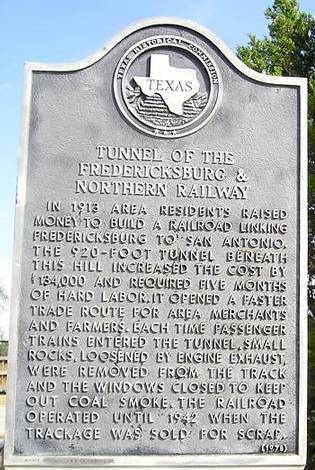 |
Tunnel of the
Fredericksburg and Northern Railway Marker
Photo courtesy Sarah Reveley, 2007 |
 |
 |
The
hole became the only railroad tunnel ever dug in Texas east of the
Pecos River
and south of the Panhandle.
It was 920 feet long, dug and blasted through solid rock with only
manpower, mule power, and dynamite. Today, if you follow FM 1376 from
San Antonio to Sisterdale,
then take FM 473 west and go beyond the road to Waring,
you'll find where an old but still paved road forms (or used to form)
a T intersection with 473. If you turn north and follow the road and
the bed of Black Creek, you will be paralleling the route of the F&N,
and just about the time you reach the ghost town of Hillingdon you'll
see, crossing the creek, the remains of the F&N's longest trestle.
Just north of that the road crosses almost directly over the top of
it and there is an historical marker you'll find the hill country's
only railroad tunnel.
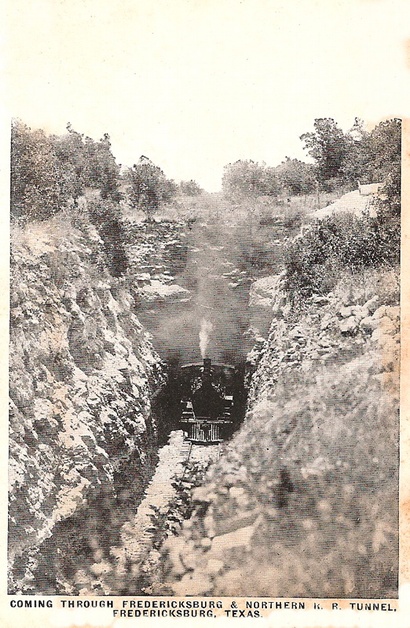
The tunnel is still there, all 920 feet of it inhabited, in the fall,
winter, and spring, by millions of bats. The bat flight from the tunnel
at dusk resembles rising smoke. During late spring, summer, and early
fall, it's home to more rattlesnakes than you'll ever want to meet
in one place again. |
 |
The light at
the end of the tunnel...and about a million bats!
Photo
courtesy Terry
Jeanson, November 2007 |
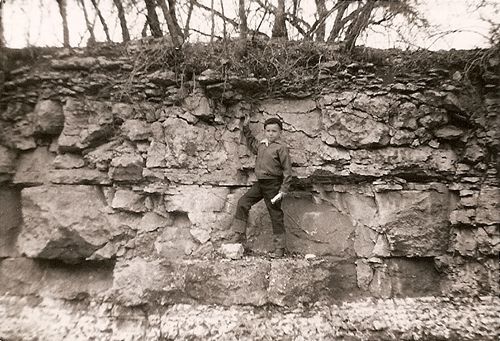
The Fredericksburg
and Northern Railway Tunnel
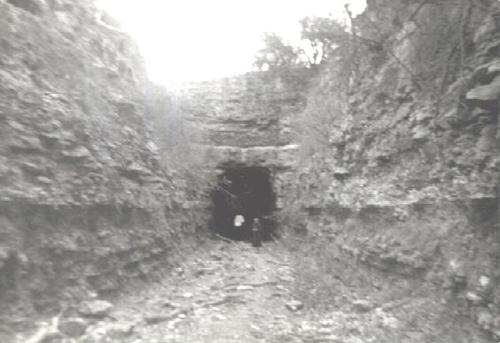
"I took this picture on one of our Sunday drives when I was a
kid... My grandmother (standing at the entrance) told us kids there
were bats in the tunnel, I high-tailed it out. The photo was taken
about 1955, the tracks were removed in 1942."
- Sarah
Reveley, October 2007 |
"See I TOLD
you my brother hightailed it outta thar when my grandfather told him
there were bats in that tunnel!! He was 8 years old. p.s. Remember
when little boys had big cuffs on their bluejeans because they grew
so fast? Mamma wrote on the back "Sunday March 22, 1952 - tunnel at
Bankersmith""
- Sarah
Reveley |
The initial estimate
which proved fairly accurate was that 14,222 cubic yards of stone
would have to be removed. Work began in April of 1913, and on July
15 the last foot of rock was blasted away. On August 26 the first
train a construction train loaded with rails to lay the last few miles
into Fredericksburg
passed through. On October 28 the last rail was spiked down. Fredericksburg
at last had a railroad.
Almost
immediately the first of the real estate shapers who continue to plague
the hill country moved in. The Mountain Townsite Company announced
the acquisition of a large tract of land atop the hill through which
the tunnel passed, and published plans for a "planned resort community"
on a 300 acre tract with "possible expansion to as much as 1500 acres."
Promised were an electric generating plant, a waterworks, and a sewer
plant. A huge clubhouse containing 75 hotel rooms, each of which would
have a private bathroom and sleeping porch, was to be built, as was
an 18 hole golf course on a separate but adjacent 100 acre tract.
Streets and boulevards the main street was to be called Berlin Boulevard
were laid out, staked and superficially graded. Special excursion
trains brought visitors to San
Antonio to examine the "ideal place for your summer home." Mount
Alamo, as the planned community was dubbed, was ballyhooed as
the "Saratoga of Texas," a reference to the famous watering hole of
the northeast, Saratoga Springs, New York. How many suckers bit the
hook is not recorded, but the only work ever done at the "planned
resort community" was grading some streets. Nothing, today, remains
of Mount Alamo except
the bare rocks of the hilltop and the cedars and liveoaks that grow
there. |
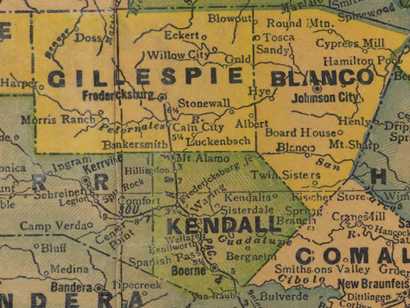 |
The road originally
passed through Cain City,
about six miles from Fredericksburg.
It was named for Charles Cain, a San Antonian who raised more money
for the F&N than any other single person. South of Cain
City it passed through Grapetown
on Grape Creek, then through a community renamed Bankersmith
after banker Temple Smith, whose unrelenting effort finally brought
in the rails. It then passed Mount
Alamo which never got off the ground and Hillingdon Station, a
flagstop for the convenience of San Antonio architect Alfred
Giles, whose summer home was at Hillingdon Ranch, to join the
SA&AP tracks at Fredericksburg Junction, about a mile east of Comfort.
Later a flagstop was added at Nichols Ranch, where what was probably
the first dude ranch in the hill country was established.
A year later the road was in receivership. The reason, largely, was
the tunnel, which had added $134,000 to the cost of building the road
in a day when an ounce of gold sold for $12.50. During the rest of
its existence, whether as the San Antonio, Fredericksburg, & Northern
or later as the Fredericksburg & Northern, the railroad never made
a penny for its investors.
Riding
the F&N could be an adventure, and timetables were often something
of a joke. During the winter icicles as much as a foot in diameter
and six to ten feet long would form inside the tunnel from seeps in
the rock, and the train crews had to stop and walk through the bore
with axes to knock them down. Since there was no wooden shoring inside,
no train proceeded directly through the tunnel, despite the old hill
country story about the German farmer who watched daily as the train
steamed up the grade from Black Creek and into the tunnel's mouth.
Finally his sons gave way to curiosity and said "Papa, how come you
alvays vatch dot train go in dot tunnel?" "Vell, poys," the old German
replied, "Vun uf dese days it's boundt to happen. Dot t'ing's gonna
miss dot hole."
In fact every train, northbound or southbound, stopped outside the
tunnel. While the brakeman and flagman walked the length of the tunnel
with pistols in their hands because of the rattlesnakes to check and
see if large chunks of tunnel had fallen on the tracks, the conductor
had all the windows in the coaches closed so the dense coal (later
oil) smoke wouldn't get inside while the train went through the tunnel.
Even at that, the pounding chug of a steam engine invariably brought
a steady rain of small rocks down from the tunnel ceiling atop the
coaches. |
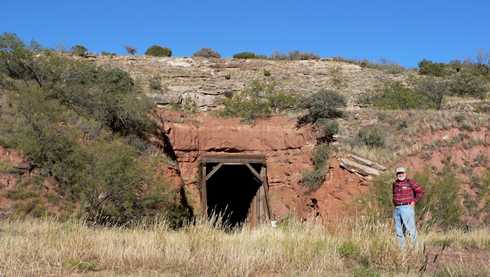 |
NOT the
Fredericksburg and Northern Tunnel
Texas' "Other Railroad Tunnel" near Quitaque,
Texas.
The highlight of the "Rails to Trails" trail about 8-10 miles S of
Quitaque.
Photo
courtesy Eric Blackwell (left) November 2006 |
In
one of the earliest preserved timetables from 1916, after the line
went into receivership yet again the SAF&N listed seven trains a week;
first class (passengers only) on Sunday and second class (mixed train)
the rest of the week. Nominal departure time from Fredericksburg
for the second class train was 12:01 PM, for the first class, 2:00
PM. The second class train was due to reach Fredericksburg Junction
a 2:15 PM, the first class to reach it at 4:10 PM. Departures from
Fredericksburg Junction for the first class run were scheduled at
6:50 PM to reach Fredericksburg
at 9:00 PM, and for the second class the same schedule. Not surprisingly,
these were intended to correspond with the arrival times of SA&AP
passenger and mixed trains going to and from San
Antonio.
It didn't often work out that way. The F&N was never an on time line.
Not only did the train have to stop to have the tunnel checked on
every run, but the crew including the conductor and porters kept shotguns
aboard except during deer season, when they kept rifles aboard. The
sighting of rabbits, turkeys, doves, ducks on the creeks, or deer
in season (and on occasion out of season) on or anywhere in range
of the right of way usually resulted in an unscheduled stop while
the crew shot Sunday's dinner. On occasion, especially when the black
bass were biting in Grape or Black Creek, the locomotive crew would
find it necessary to stop "to oil the bearings" or something similar
about the time the train crossed one of the creeks. While the bearings
got oiled fishing lines got wet, to cook some black bass on the heat
of the boiler backhead. The bass would be done to a turn about the
time the train pulled into Fredericksburg Junction.
When hunting and fishing didn't delay the train the condition of the
roadbed often did. Since the F&N spent most of its existence in receivership
to one group of creditors or another, roadbed maintenance was sporadic
at best. Only parts of the line got rock ballast immediately upon
construction, and much of the line never was ballasted with anything
more firm than sand. Rains would wash out most of the ballast, leaving
the rails and ties lying on wet, often somewhat spongy ground. Speeds
of 2 or 3 mph under such conditions were the rule, and it could take
ten hours or more to get to Fredericksburg
from Fredericksburg Junction after a hill country thunderstorm. Since
most of the early trestles on the line were of timber, washouts during
rainy weather were common, and it was not unusual for the train to
find itself stranded between two creeks, both trestles having been
washed away in flash floods, the passengers and crew facing a long
and muddy hike to the next station.
In the early 1920s a problem other than water struck the timber trestles.
The big trestle over Black Creek just south of the tunnel caught fire
and much of the center section burned. It was eventually replaced
by the stone pier trestle that still stands today, one of the two
remaining relics of the F&N.
The
F&N had one good thing going for it if there was going to be a direct
rail connection between San
Antonio and the Panhandle,
and a great many railroad men (and San
Antonio and Panhandle businessmen as well) wanted one, the F&N
had already bridged the greatest obstacle, the Guadalupe Pedernales
divide. Until the rails reached the Cap Rock there was virtually nothing
a train couldn't go around. A number of schemes were advanced to continue
the F&N north into Menard,
Eden,
and San
Angelo, to connect with roads already built into the Panhandle.
While nothing ever came of the Menard
to Fredericksburg
connection, much of the rest of the planned line was eventually built.
The F&N issued its final timetable on September 3, 1929, advertising
one northbound and one southbound train a day from Fredericksburg
to the junction. By the late '30s the line's sole stockholder was
Dr. O. H. Judkins of San
Antonio. On July 25, 1942, the official documents that enabled
Dr. Judkins to declare the road abandoned and offer it for scrap were
approved by the War Production Board. In spite of last ditch efforts
to save it, the hill country railroad was no more.
Portions of the steel rail were sold to the US Army to build sidings
at military encampments across the country, and six carloads of rail
eventually found their way to Australia to help build badly needed
railroads there. Some of the timbers from the trestles were bought
by Uncle Sam and became piers and abutments along the strategically
important Alcan Highway.
Since the road was abandoned after Pearl
Harbor, it didn't share the shame of companies like the Austin
Transit Company, which sold much of its street rail to Japan in the
1930s, when it made the transition from streetcars to buses. American
soldiers found, as reinforcements in the roofs of Japanese pillboxes
and machine-gun and artillery bunkers on Guadalcanal and other Pacific
islands, sections of light steel rail still bearing the mark "Austin
Transit Co. Austin, Texas."
Only two real relics remain of the old F&N the Black Creek trestle
and the tunnel. They are the last remnants of a dead era a time when
the presence of a railroad brought life to a town and the lack of
one killed it. Fredericksburg
survived, thanks to roads built during the 1930s, but Cain
City and Bankersmith
are ghost towns, Grapetown
isn't much better, and not even the graded streets are left at Mount
Alamo.
© C. F.
Eckhardt
"Charley Eckhardt's Texas"November
15, 2006 column
More Texas Railroads |
|
|
 HOME
HOME