|
| Maybe
you have been to New
Corn Hill and thought you were in Corn
Hill, or Cornhill depending on your spelling preference and which
map you're using. What some people think of as Corn Hill is really
New Corn Hill, the place on FM 1105 where rolling pasture and prairie
converge at the beautiful and historic Holy Trinity Catholic Church. |
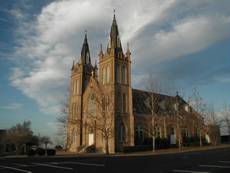
The Holy Trinity Catholic Church in New
Corn Hill
Photo Courtesy Bob Crain, 2-04 |
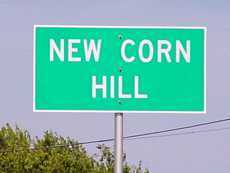
Until recently there wasn't a sign on FM 1105 announcing a driver's
arrival in New
Corn Hill. The nearest sign was for Theon,
a mile or so south. As Monk Ivicic will tell you, "Theon doesn't have
anything to do with it."
Ivicic, who retired from the Texas Department of Transportation last
year, took it upon himself to get signs posted on FM 1105. People
were getting Theon
and New
Corn Hill confused. The new signs are part of an attempt to put
an end to the confusion. |
|
The site of the original Corn Hill community is now
referred to as Old
Corn Hill but is spelled Cornhill on old maps and on a historical
marker at Cornhill Cemetery. The site is on Willis Creek, two miles
south of Jarrell,
just east of the IH-35 frontage road. |
Signs alongside the frontage road today point you to
the Cornhill
Cemetery, but there are other remnants of the once-thriving community
before you get there: a windmill, some old houses and outbuildings,
and an abandoned two-story structure that was once a hotel and later
a residence.
These are the few reminders left of a time when Cornhill was a thriving
community, back in the days before the Bartlett and Western Railroad's
track bypassed the town.
Ivicic says a trio of Cornhill landowners refused to grant the railroad
right-of-way to the Bartlett and Western so the railroad laid its
tracks just north of town. The tracks ended at a new town on the prairie,
Jarrell. |
 |
To
say people in Cornhill packed up and moved to Jarrell
wouldn't be exactly true because there was no packing to it. Instead,
most of the people in Cornhill hooked their houses to a John Case
steam engine and moved to Jarrell, en masse, inside their houses.
"If those landowners had used logic, they would have let the railroad
go through their property," Ivicic says. "Old Corn Hill would still
be there."
Instead, the old community has faded from view and memory to the point
where a lot of Williamson
County natives don't know there ever was an old Cornhill. "It
was news to me," Ivicic says. "It's news to most people."
Ivicic's ties are to New Corn Hill. He has researched the area's history
and talked to long-time residents whose families go back generations.
He has collected some amazing old photographs, including one that
shows a mercantile and possibly a saloon located next to the Holy
Trinity church. The buildings were owned by his great grandfather,
Ignac Kubacac. |
 |
|
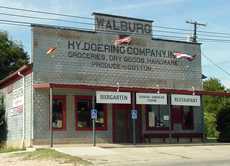
Ivicic says the unofficial boundaries of New Corn Hill extend roughly
from Jarrell
to Schwertner
to Walburg.
That includes property owned by Bill Schwertner, which was once the
heart of Cornhill. |
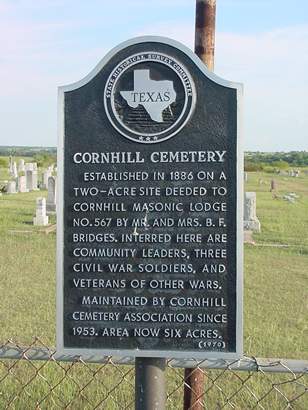
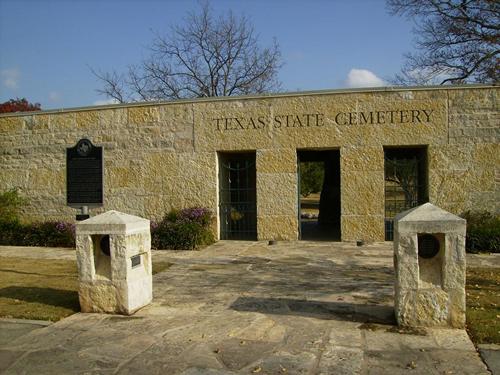
The
most tangible reminder of the old community is the Cornhill
Cemetery, which was established in 1886. According to a plaque
outside the cemetery's gates, community leaders, three Civil War soldiers
and soldiers from other conflicts are buried there.
Inside is a plaque next to the headstone of James G. Wilkinson, a
veteran of the Battle
of San Jacinto and three sessions of the Congress of the Republic
of Texas. The headstone was moved to Cornhill from Burleson
County. |
|
|
 HOME
HOME