|
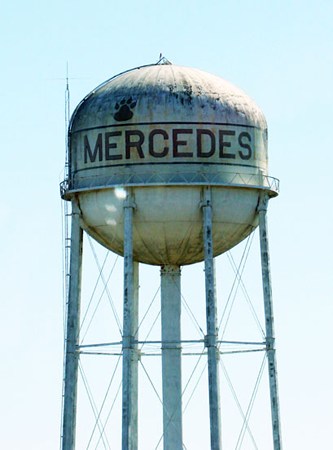
MERCEDES, TEXAS
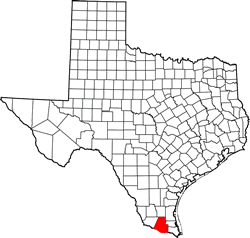
Hidalgo County,
South Texas
26°8'58"N 97°55'7"W (26.149315, -97.918675)
U.S. Highway 83
E of Weslaco
W of La Feria
21 Miles E of McAllen
14 miles W of Harlingen
9 miles N of the Progreso–Nuevo Progreso International Bridge over
the Rio Grande
Population: 16,604 Est. (2019)
15,570 (2010) 13,649 (2000) 12,694 (1990)
|
 |
History in
a Pecan Shell
First settled
by Spanish ranchers in the late 1770s, the land was granted in 1789
to Juan José Ynojosa de Ballí. It was later acquired by Ramón and
Manuel Cavazos, who founded the Anacuitas ranch in 1850. The land
continued to be owned by the Cavazos family until developer Lon
C. Hill, Jr. appeared around 1900. Hill bought 45,000 acres that
extended sixteen miles from the Rio Grande, including property that
would become Mercedes.
Hill constructed the Estarito Canal and in 1904 he developed a town
(one mile east of present-day Mercedes). Hill modestly renamed the
town Lonsboro and after developing it, sold it to new owners
who renamed it Diaz (perhaps after the Mexican head of state
Porfirio Diaz). The community underwent several more changes of
name until Mercedes was (mercifully) agreed upon. Some sources say
that Mercedes was the wife of Porfirio Díaz, but no documentation
backs up the claim.
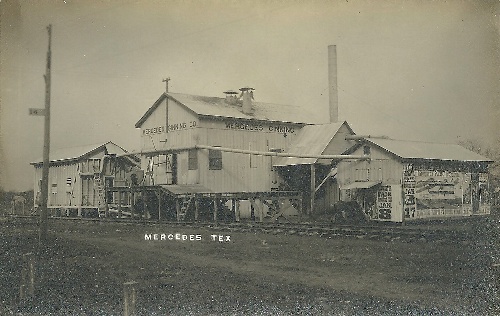
In July of 1904, Mercedes became a stop on the Sam Fordyce spur
of the St. Louis, Brownsville and Mexico Railroad.
Northern settlers were brought down by an aggressive promotional
campaign. After 1907 large-scale citrus fruits and vegetable crops
were introduced. Around that time the town had a enviable population
of 1,000 residents.
The Rio Grande flooded in 1908 and Mercedes was one of the towns
hardest hit. The population reached 2,000 by 1915.
Border incursions and unrest caused by the Mexican Revolution required
a military presence on the border and Camp Mercedes and Camp Llano
Grande were laid out – just outside the Mercedes city limits. The
two camps had a combined population of 15,000 soldiers, dwarfing
the town. By 1925 the population had increased to 3,414 in 1925.
The 1940 population grew to 7,600, bolstered by an oil discovery
in 1935. In 1952 the B&P Bridge Company was formed by local businessmen
and a contract was signed for a new international bridge. Construction
was begun in the fall of 1952 and the bridge was completed in one
year.
Mercedes’ population reached 10,065 in 1952, increasing to 10,943
by the early 1960s. The 1980 census reported 10,354 residents, growing
to 12,694 for 1990.
|
|
|
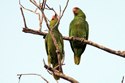
Green
Parrots by Ken Rudine
Mercedes is where we see the most parrots. Groups often roost there
in or near the same place... more
|
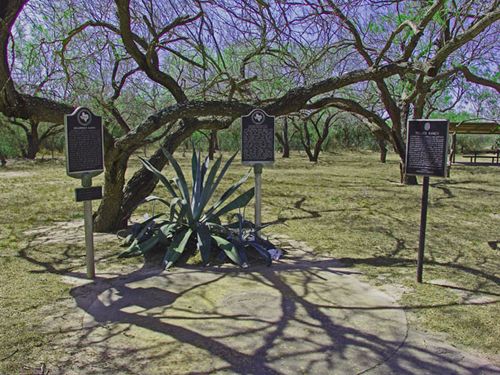
Historical markers
in Relampago
Off Highway 281
4 Miles SW of Mercedes
Photo courtesy Ken
Rudine, March 2008 |
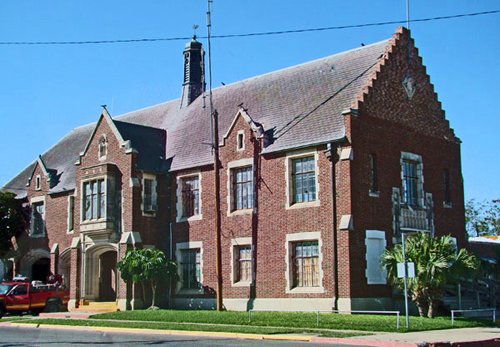
Mercedes City
Hall & Fire Station
Recorded Texs Historic Landmark
Photo courtesy Ken
Rudine, February 2008 |
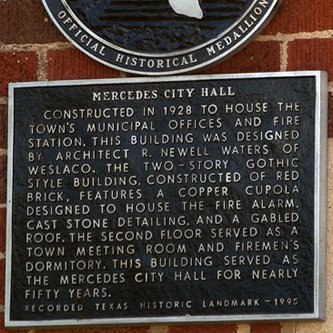
Mercedes City
Hall Historical Marker
Photo
courtesy Ken
Rudine, February 2008 |
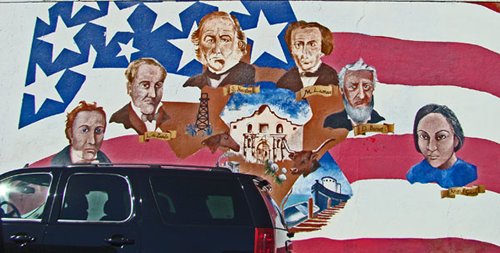
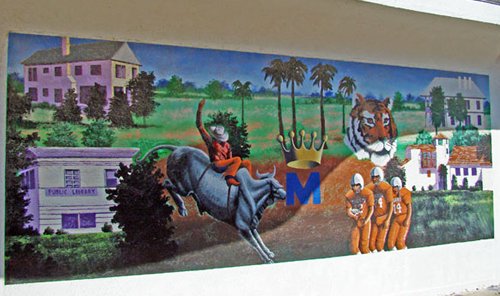
Murals in Mercedes
Photo courtesy Ken
Rudine, February 2008 |
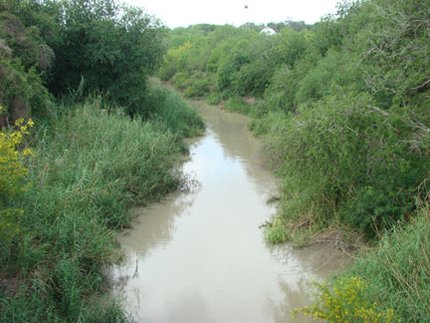
Arroyo Colorado
viewed from 491 bridge
S of Mercedes city limits sign.
Photo
courtesy Ken
Rudine, April 2008
See Texas Rivers |
| Texas
Escapes, in its purpose to preserve historic, endangered and vanishing
Texas, asks that anyone wishing to share their local history, stories,
landmarks and recent or vintage photos, please contact
us. |
|
|
 HOME
HOME