|
Dido Cemetery
Photo courtesy Sam Maddox, 2006 |
History
in a Pecan Shell
Founded
around 1848 - Dido was once a thriving community named for a mythical
Queen of Carthage. The town had its own post office, stores and a
promising future until it was bypassed by the railroad
in the 1890s.
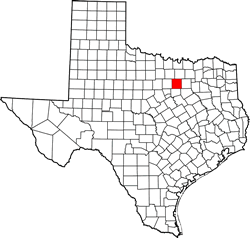
The most obvious reminder of the former town is the 1,000-grave Dido
Cemetery.
In 1887, land was donated for a school, church and cemetery. Additional
land was donated in 1894 by Dr. Isaac Van Zandt, son of Isaac L. Van
Zandt - the namesake of Van
Zandt County. (See letter below.)
The earliest grave in the Dido cemetery is that of one-year-old infant
Amanda Thurmond (1878-1879) granddaughter of an early settler. |
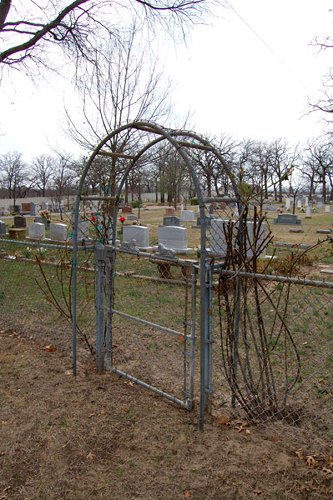
Dido Cemetery
gate
Photo courtesy Sam Maddox, 2006 |
Dido, Texas
Today
“At the north end
of Eagle Mountain lies a town that is forgotten but not lost. We found
the slab of the post office at the corner of Peden Road and FM 1220.
The growth of Fort
Worth is moving north and the growth of Alliance Airport is moving
south. Right in the middle of both of those growth booms lies Dido,
Texas.
The oldest church in Tarrant
County sits here, the Dido Methodist Church. The Dido Women’s
Club are the caretakers of the community center and the Dido announcements
sign. Anchoring the town is Blue Bayou.
It is a ghost town in all its character and charm. All it needs is
a mayor and a post office box and it will be back to its glory days.
[It is] still rich in the historical sense, as well as the ghostly.
Rumors are the bridge at Indian Creek is where Cullen Davis threw
his earthly goods into the lake. Dido dogs still roam but are eerily
quiet for they never seem to bark. There are many parts of the town
where the noise of parties can be heard, but there are no houses or
inhabitants on those spots.
It’s the most well-kept secret in all of Texas.”
- Dennis Heerwagen, August 26, 2010
Not any more. - Ed |
 |
Dido Cemetery
marker
Photo
courtesy Sam Maddox, 2006 |
Historical Marker
Dido Cemetery
The earliest marked
grave in this cemetery is that of Amanda Thurmond (1878-1879), granddaughter
of Dave Thurmond, who in 1848 first settled this area. Dempsey S.
Holt donated three acres in 1887 for a school, church and cemetery.
Dr. Isaac L. Van Zandt, a pioneer physician and Confederate veteran,
deeded additional land in 1894.
The Village of Dido was named for the mythological Queen of Carthage.
A thriving community with a post office and stores, Dido declined
after the railroad bypassed it in the 1890s. Among the 1,000 graves
here are those of many pioneer families.
(1977)
[More Texas Cemeteries ] |
Dido,
Texas Forum
The Smith
Family Chronicles: Two Routes from Virginia and A Reunion in Texas
I descend from Phereby Turner & John Smith. John Smith's will was
dated in 1805 Anson County NC. I have traced [the family] back to
Sir William Harris who married Alyce Smythe/Smith, the sister of
Sir Thomas Smythe who was the Treasurer of the Virgina company and
was appointed by the King to settled Jamestown after the first two
failed attempts. He was also Ambassador to Russia, Governor of the
East India Company, and held other other notable positions. His
father [also] Sir Thomas Smythe, was wealthy enough to donate sums
to Queen Elizabeth I so that England could arm against and defeat
the Spanish Armada. I believe this is the reason my Smith got the
abundant land grants from the King of England. England owed them
a debt for helping save the country. The Smiths that migrated westward
were so prominent and respected that other families gave their children
the first name of Smith. Texas' Smith
County had many Smiths settle there.
In Texas the name Throckmorton is both a county
and city
as well as the name of a street in downtown Fort Worth. Sir Throckmorton
was a protégé of Sir Thomas Smythe in England in the
1500's. Prior to changing the name from Smythe to Smith they were
Carringtons. The Carringtons were an order of the Knights Templar
who escaped England. When the Templars were rounded up, they returned
as Smythe's. Between the years 1750 and 1790 in Anson Co NC the
name John Smith is mentioned most often in local land transactions.
The Smiths came out of VA in two directions. One South through NC
and SC with the children going westward through GA, MS, AL, and
Texas. The other went directly westward through KY, TN, AL and connected
in the 1800's with the families who had taken the southern route.
My research shows these families started in VA together and 400
years later met at Dido and the surrounding area where I live today.
The census records from 1850 to the present and the family wills
prior to those dates confirm this. The burial plots at Dido have
the families together in the 1800's as they were in the 1600's.
Much of this is in history books and others [are family histories].
I have cousins all over the country who are assisting me but the
more I have become involved in this, the larger the story grows.
The Dido cemetery will link to Davy Crockett, Thomas Jefferson,
Lyndon B Johnson, George Washington and others. The Smith Family
descendants buried at Dido go back to the founding of this country.
- Bob Thomas, Saginaw, Texas, August 29, 2007
Subject:
Dido Cemetery
I am a retired Finance Director and now do part time consulting
and serve as an expert witness for law firms nationally. Most of
my time is spent doing genealogy. Both my mother and fathers lines
document to the Royal families of Europe. While tracing the migration
on my fathers side I found that a Hankins (my grandmother was Mary
Jane Hankins) was buried at Dido cemetery. I live in Saginaw Texas
which is 15 minutes from there. I went there Thursday afternoon
and was totally stunned. Not only were there 5 Hankins graves, there
were many surnames that connect to my family on both sides that
document back to Jamestown Society ancestors as well as Halifax
North Carolina founders and a heavy dose of names out of Isle of
Wight Virginia and other Virginia counties. Here are at least three
confirmed burial sites of Blue Blood (now Blue Bones I guess) but
with what I am finding it could be one of the largest [groupings]
in one cemetery in Texas. I was back out there today for four hours
and it will take weeks to catalog exact positions of all the grave
sites that are linked. This was another colony as they moved west
and I have traced these carefully. I need additional help with this
as the other genealogist and family members are scattered over the
country. It seems these families (MY families) were close in their
migrations, seldom marrying outside the inner circle. - Bob Thomas,
Saginaw, Texas, August 18, 2007
Subject:
Dido Days every year on the last Sunday in April
My name is Barbie Williams and I'm on the Dido Cemetery Board of
Directors. We still have "Dido Days" every year on the last Sunday
in April. This year it will be on April 30th at 12:30 PM. We still
have a picnic, and a business meeting there at the cemetery. Weird
as it may seem, a picnic at the cemetery is really pretty neat.
At least it is at Dido. I believe it is one of the most beautiful
and well kept cemeteries there is. One gentleman has been coming
to Dido Days for nearly 90 years. He said he remembers coming for
the "yearly cemetery clean-up" in a covered wagon with his parents.
Nowadays Dido is maintained year round so we mainly just meet to
conduct business and have food and fellowship.
I just learned that famous Texas song writer, Townes Van Zandt,
is buried there (well, some of his ashes). He was Isaac L.Van Zandt's
great grandson. Townes wrote the song "Pancho and Lefty" sung by
Willie Nelson. Lots
of neat history in Dido. - Barbie Williams, April 19, 2006
Subject:
Dido Texas
I can't believe you have a website. I used to come with my grandparents,
Ruby Caldwell Hill and George Earnest Hill to the "reunion" at Dido
in April in the 60's. They used to meet in the spring to clean the
cemetery, but when we went, it was mainly a get- together with lots
of good food. Amanda "Mandy" Thurmond, the first person buried there
was my granddaddy's (G.E. Hill) aunt, the twin sister to his mother,
Mary Thurmond. Mary and Amanda's parents, Jim and Rebecca Thurmond
lived in Dido. Mary Thurmond married Allen Hill.
According to my mother, Mary Sue Hill Ingram, her grandfather, "Daddy"
Allen was a boisterous, "good will" man, a town organizer. He had
a chair on his front porch and would "holler" greetings to the townsfolk
as they passed by. She said he was pall bearer at everyone's funeral,
probably due to his size. Anytime he met someone who was hungry,
he would invite them to his house to eat. His wife, Mary, was a
small woman, evidently a very good cook. She also visited the neighbors
every day and was quite a talker. My grandaddy said she visited
the neighbors because Daddy Allen never let her get a word in at
home. The best story Mother told me was of Daddy Allen selling watermelons
to raise money for the Dido cemetery. She said he had the watermelons
iced down in big barrels and was slicing and selling them with a
flourish. What a picture! I don't know how many descendents I have
in Dido from the Thurmond and Hill families, but my grandparents
and my Daddy, Frank Douglas Ingram, are buried there. It's a beautiful
place with lots of trees and a view of Eagle Mt. Lake. I have very
fond memories of my time with my grandparents there.
If anyone has info on when Dido Day is this year, please email me
at cityama@mac.com - Diana Lane, April 04, 2006
Subject:
A Dido Correction
On your website, you state that: "In 1887, land was donated for
a school, church and cemetery. Additional land was donated in 1894
by Confederate veteran Dr. Isaac L. Van Zandt - the namesake of
Van Zandt County."
It's a common error, one that started decades ago and is still being
repeated. The first problem is the Van Zandts - there are three
prominent members of the family; Isaac Van Zandt, the father of
Dr. Isaac Van Zandt and Major K.M. Van Zandt. It was the elder Van
Zandt for whom Van Zandt County, Texas was named. He also helped
frame the Texas Constitution and served in Washington representing
Texas. It was his son, the Doctor, who lived in Dido. His brother,
K.M. Van Zandt was prominent in early Fort Worth (1865) and also
had land and a home in Saginaw. Even the family gets them confused.
I'm trying to get this thing untangled - one piece at a time. Thanks,
Art Jones, Lake Worth, Texas, March 28, 2006
I live down
the road from Dido (in Saginaw, Texas) and my buddies and I go out
there all the time (there's a couple of bars, along with the cemetery).
Its certainly not a "ghost town", though. Indian Creek has maybe
30 people there plus a new housing division ("the Resort") being
built. But, Dido itself has hundreds of people living there; they
just don't live right off of Morris-Dido road. Yeah, the railroad
did by-pass Dido way-back-when (for Saginaw), and the town no longer
has a post office (hence, it isn't a "real" town), but its still
alive and well. The foundation of the old post office is at the
split in the road, and there's also a few old buggy wheels there,
too. Anyway-Dido's faded, but not gone. - S. Williams, November
12, 2002
I live in Dido.
Although it is not considered a town anymore, it is still a very
large community. In addition to the cemetery, we also have a community
center, a church and a volunteer fire deparment, hidden off of Bud
Cross Drive on McRee Street. Several of the old-timer's could tell
you a lot about the community once known as the town of Dido. Everyone
knows everyone here in Dido. - Terry Lee--Dido Resident since 1977,
October 29, 2002
I just moved
to Ft.Worth, TX. area and saw that Dido Texas was in your ghost
town list, so I thought that I would take a drive and see if I could
find it. Well after about 30 minutes of looking at a map and driving
in the new area of Ft.Worth, I came across an old auto repair shop
and ask the man working there if he could tell me where Dido was.
He gave me the directions that I needed and then told me that there
isn't really much left out there, but if I wanted to see it then
that was my business. I did find the town of Dido which is pronounced
with a long I sound, and There is a little bit of new construction
going on there, with a new subdivision being built right by the
cemetery. There are still a bunch of old houses and a couple of
abandoned shacks out there, but there are still people living out
there. ..... The town is very small, which is why it's not on a
map, but it does still exist. - Dan Shea, May 08, 2002
|
| Texas
Escapes, in its purpose to preserve historic, endangered and vanishing
Texas, asks that anyone wishing to share their local history, stories,
landmarks and recent or vintage photos, please contact
us. |
|
|
 HOME
HOME