|
 |
History in
a Pecan Shell
Settlement
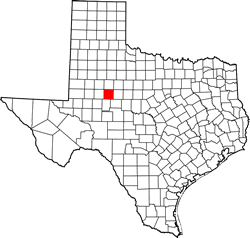
of the region began in the 1890s, and a small community developed
around the rural school of Liberty, established in 1899 near Wildhorse
Creek. Early settlers included the families of R. E. Hargrove, J.
L. VanZandt, P. W. Crump, and J. D. Falkner. A post office was opened
there in 1902 and was named Herbert for Colorado
City postmaster Herbert Hazard.
In 1909 the office was renamed Spade after the Spade Ranch.
The post office served the community until it was moved to Colorado
City in 1912. By 1910 Spade had the post office, a general store,
a gin, a blacksmith shop, a school, a Baptist church, and a Woodmen
of the World Lodge; at that time the community was a stop on the Colorado
City-Sterling
City stage line.
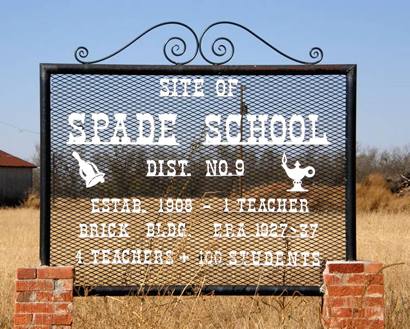
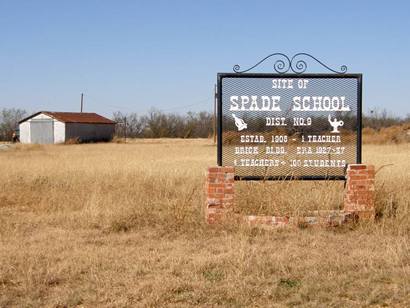
The old Liberty school was renamed Spade in 1910. In 1930, 101 students
attended the school and the district encompassed 124 square miles.
The Spade school was consolidated with that of Westbrook in 1938.
The community was locally known during the early 1900s for its Fourth
of July picnics and political rallies, one of which was attended by
James V Allred. A Methodist church was built about 1930, and by 1947
the town reported one store, two churches, and ten residents. One
church and a cemetery remained in 1972.
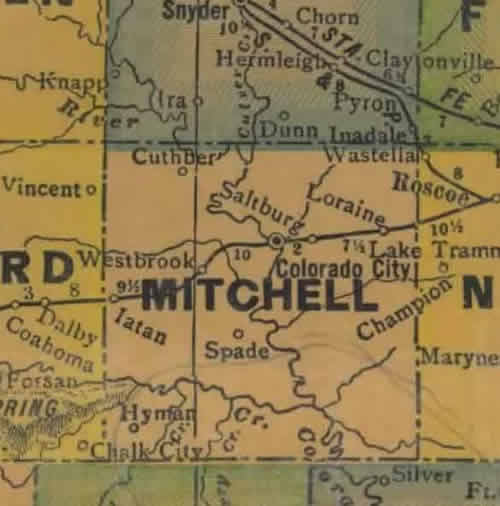
Spade was still shown on county maps in the 1980s.
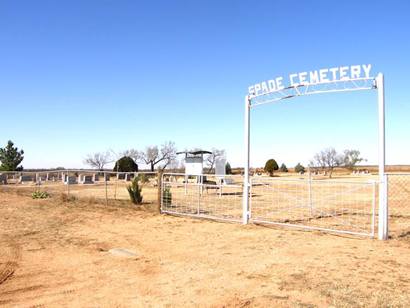
See Spade Community Cemetery Historical
Marker |
 |
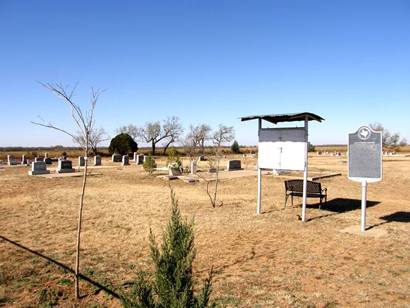 |
Cemetery Historical
Marker:
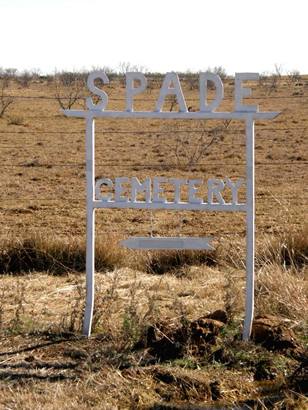
Spade Community
Cemetery
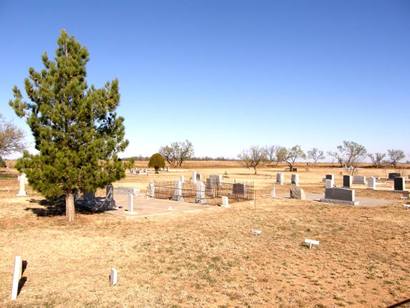
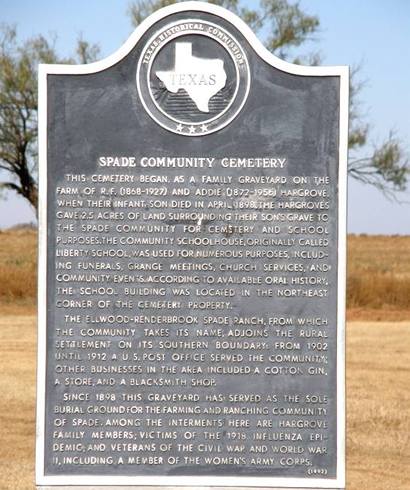
This cemetery began
as a family graveyard on the farm of R.F. (1868-1927) and Addie (1872-1956)
Hargrove, when their infant son died in April 1898. The Hargroves
gave 2.5 acres of land surrounding their son's grave to the Spade
Community for cemetery and school purposes. The community schoolhouse,
originally called Liberty School, was used for numerous purposes,
including funerals, grange meetings, church services, and community
events. According to available oral history, the school building was
located in the northeast corner of the cemetery property.
The Ellwood-Renderbrook Spade Ranch, from which the community takes
its name, adjoins the rural settlement on its southern boundary. From
1902 until 1912 a U.S. Post Office served the community; other businesses
in the area included a cotton gin, a store, and a blacksmith shop.
Since 1898 this graveyard has served as the sole burial ground for
the farming and ranching
community of Spade. Among the interments here are Hargrove family
members; victims of the 1918 influenza epidemic; and veterans of the
Civil War and World
War II, including a member of the Women's Army Corps. |
 |
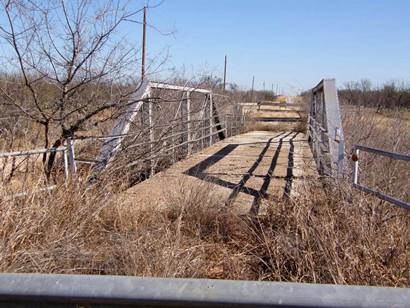
A closed bridge
near Spade
Photo courtesy Barclay
Gibson, December 2009 |
SPADE, TEXAS
by d.knape
A town too small
to make the grade,
is all that can be said
of Spade,
It disappeared
there is no doubt,
now no one knows
its whereabouts.
© d.knape
January 26, 2016 |
| Texas
Escapes, in its purpose to preserve historic, endangered and vanishing
Texas, asks that anyone wishing to share their local history, stories,
landmarks and recent or vintage photos, please contact
us. |
|
|
 HOME
HOME