|
DUMAS, TEXAS
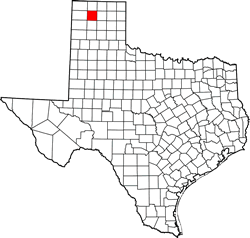
Moore County Seat,
Texas Panhandle
35°51'45"N 101°58'1"W (35.862478, -101.966931)
Junction of US 87 and 287, and Hwy 152
34 miles S of Strafford
49 miles N of Amarillo
71 miles W of Pampa
ZIP code 79029
Area code 806
Population: 13,827 Est. (2019)
14,691 (2010) 13,747 (2000) 12,871(1990)
Book
Hotel Here › Dumas
Hotels |
| According to
the State Travel Guide, Dumas offers "scenic beauty in rugged
canyons and hills of Canadian
River brakes." |
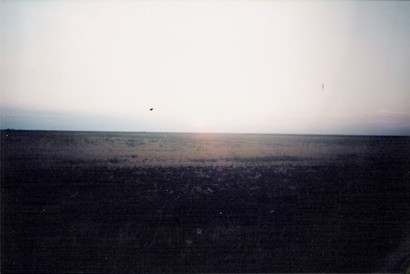
West Texas sunset
10 miles outside of Dumas
Photo courtesy James
Feagin, 2001 |
History
in a Pecan Shell
Dumas’
namesake was Louis Dumas, an investor in the Texas
railroad lands. Dumas formed the Panhandle Townsite Company.
He and other investors saw unlimited opportunitiest here and after
forming the Moore County Township Company, the town that was to
bear his name was platted.
The first building housed the company office, a hotel, a general
store, and the first post office. When Moore
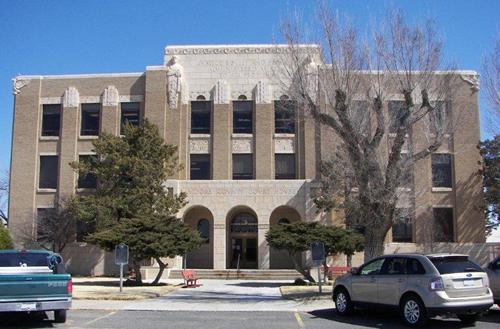
County was organized, Dumas became the county seat and a courthouse
soon joined the other buildings.
In the early 1890s the town was devastated when grasshoppers ate
nearly all of Moore
County’s flora. The following year a severe winter drove away
many of the county’s pioneers, depleting the population nearly to
extinction. It was so bad that even Mr. Dumas himself “went back
where he came from.”
The town may be on the list of ghost
towns if it wasn’t for the tenacity of the Nield family who
toughed it out. The town was without a railroad connection and any
building material or supplies had to be brought overland from Amarillo.
With a population of less than fifty people, Dumas was a town living
on the edge, both literally and figuratively when it was announced
a railroad was planning on building through town. The population
almost instantly quadrupled, which meant that it barely reached
100 people
The railroad venture failed, but the seed was sown for growth, nonetheless.
The population doubled to 200 residents.
Finally, in the mid 1920s, oil and natural gas were discovered and
residents were beginning to feel things were finally changing for
the better.
A railroad (the
North Plains and Santa Fe) finally arrived in 1931 and despite the
Great Depression, Dumas expanded. A new courthouse
was built and a fire department was organized. The town received
its first paved streets.
Dumas surprised
the census department by reaching 2,500 people at the height of
the Great Depression. The installation of several carbon black plants
swelled the population to over 6,000 by 1950.
The drilling of new water wells and the building of new petro-chemical
facilities increased the population to new heights. In 1960 it was
8,477 in 1960 and twenty years later it had reached over 12,000.
By 2000 it had reached a population nearing 14,000.
|
Dumas, Texas
Landmarks / Attractions:
|
Eight City
Parks
"Windows
on the Plains" Museum -
1820 S. Dumas Ave. 806-935-3113
Lake
Meredith - Southeast of Dumas
Fishing, swimming, boating and water skiing.
Dumas
Hotels - Book Here
|
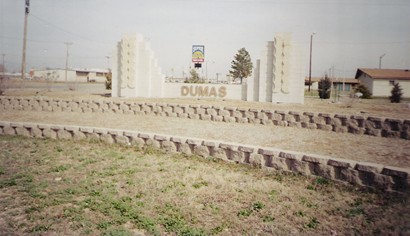
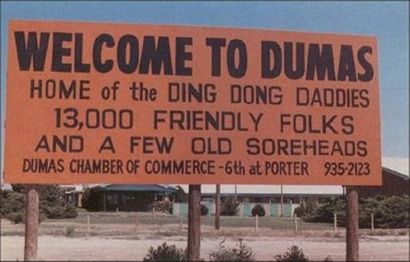
Dumas welcome
sign
Postcard courtesy www.rootsweb.com/ %7Etxpstcrd/ |
Water tower
and statue in Dumas
Photo courtesy James
Feagin, 2001 |
Dumas, Texas
Chronicles
Dumas,
Texas, 1920 by Louise George
Mill Boyd - "The first I remember of Dumas was the first night we
got here. It was along in April or May, and we were out of Dumas
a few miles in a Model T car coming from Amarillo, and a rain had
just gone through and cleaned everything off, and it looked so pretty.
There was not a tree, not a fence - nothing. Out about three miles,
along about the Stallwitz farm, I looked and I could see the town.
I could see that white courthouse with that cupola on top with just
a few houses here and there, dotted around. Dumas was so little
and it looked so lonesome. I thought, 'Oh dear! Where have I come
to?'...
School
Days by Louise George
J.T. Brown - “...When I was in school, the school was up there where
the Christian Church is now, up there on west Fifth or Sixth, somewhere
in there. There were two big old two-story buildings there for schoolhouses.
The class I graduated with in 1931 was the last class to finish
in the old school building..."
Remembering
Christmas by Louise George
|
Dumas Tourist
Information
Dumas and Moore
County Chamber of Commerce: 806-935-2123 |
Dumas, Texas
Forum
Subject:
Refinery Fire
I will never forget July 29, 1956. I was five years old. The fire
siren in Sunray blew and we could
see the smoke from the refinery north of Dumas. My mother was very
scared because my Dad was a volunteer fireman in Sunray. When the
phone rang later my mother started crying... Dad had been badly
burned when one of the tanks exploded. Later, Dad said he could
tell the tank was about to go and he and the men with him began
to run. There was a small berm nearby and Dad was able to get to
it. The flames went over Dad and burned the back of his head and
severely burned his arms... but he survived as did other men from
the Sunray volunteer fire department. Sadly, others from the small
community fire department did not. Even though I was very young
at the time, I remember some of the men who died that day and how
the whole town of Sunray mourned.
Yes, they are heros.... from a time and place where heroism really
meant something. - Randy Foshee, Canon City, Colorado, September
01, 2006
Subject:
Fire at Diamond Shamrock July 29, 1956 - 50 Year Memorial
There were 19 men killed by fire and explosion with 33 people injured.
Four men who were fatally injured were employees of the refinery,
and thus not included as members of either Dumas or Sunray Volunteer
Fire Departments.
At least one man (D.C. Lilley) had his name misspelled [on the monument].
His correctly spelled name is D.C. Lilley. As his son I have quite
a lot of info on this incident. There are monuments in Sunray
and Dumas and a 50 year memorial is planned for 2006 in Dumas.
The NYC firefighters were all headed upward on 9-11-01. They are
among heroes anywhere. Out of over 5 million people, 343 firefighters
died that day. On July 29, 1956, nine men ( 8 firefighters and 1
refinery employee) died among a town with a population of 1,240.
I consider them all heroes as well as the men who found them and
carried them to medical services. (We don't know who most of them
were.) They have my eternal thanks. The burial of most of these
men was at Lane Memorial Cemetery located one mile N. of
Sunray and approx 1/4 mile east on
a (now paved) FM road.
Four of these men were members of the First Baptist Church of Sunray.
They were Broxson, Emmett, D.C. Lilley, and Weir. Funerals were
held on July 30 and 31, 1956 with mourners lining both sides of
the road from the church to Lane Memorial Cemetery.
I lived northwest across from the church and watched these funerals.
My father's being the last. All funerals were closed casket from
this refinery fire and explosion.
My biggest regrets are my family not meeting my father.
Thanks for the article and time you've spent setting up this website.
May God Bless. - Larry Lilley, Retired Fire Dist. Chief of the Lubbock
Fire Department, Active duty: 27 years, 2 months, Lubbock,
Texas, March 19, 2006
|
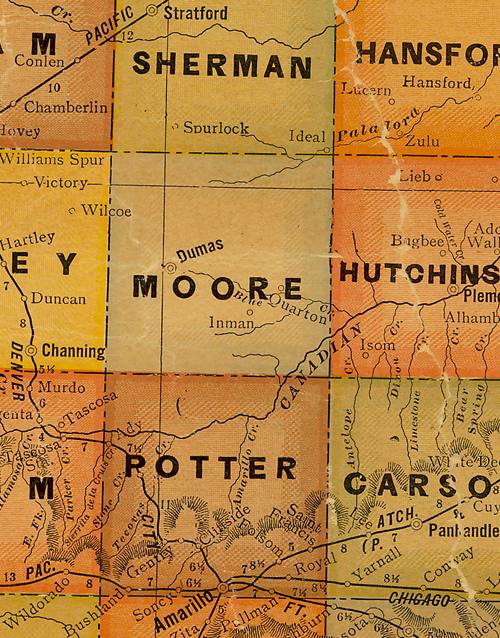 |
Moore
County 1920s map
From Texas state map #10749
Courtesy
Texas General Land Office |
| Texas
Escapes, in its purpose to preserve historic, endangered and vanishing
Texas, asks that anyone wishing to share their local history, stories,
landmarks and recent or vintage photos, please contact
us. |
|
|
 HOME
HOME