|
|
Around
Labor Day of each year, as Sabine
Pass prepares to celebrate its Confederate holiday, Jefferson
County citizens hear much about the 47 Irish defenders of the
seaport city. Scrappy Kate Dorman is by no means as well-known as
Lt. Dick Dowling,
but to those Federal troops who had occasion to meet her, she left
an indelible imprint on their memories.
One reason I enjoy keeping the memory of this dear lady alive is because
95% of the Texas historical markers of that period commemorate men
only. A thousand markers could not reconstruct the harshness of life
in the mid-nineteenth century for countless pioneer Texans. However,
it was doubly harsh for the pioneer women, and one need only to read
the county mortality censuses of that period to see how many young
women sacrificed their lives during childbirth.
Until recently,
a plaque in Sabine
Pass State Park paid some tribute to our Irish heroine, but it
was removed while construction work was in progress there some years
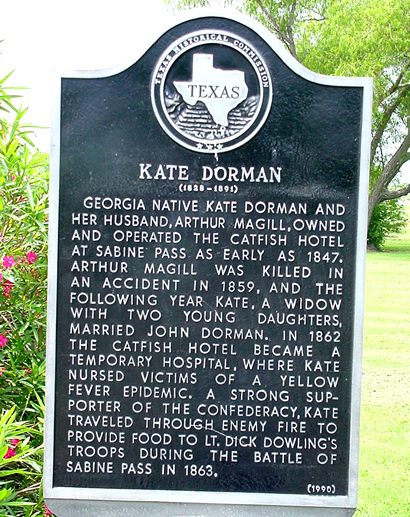
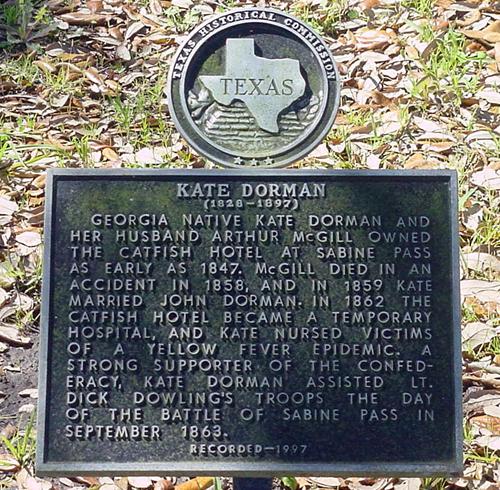
ago and was never remounted. However, a state historical marker has
since replaced it. In its issue of December, 1973, Civil War Times
Illustrated published a photograph and a brief note about the diminutive,
4-feet, 10-inch Kate; so did Blue & Gray Magazine in its issue of
September, 1986.1 |
 |
 |
Of
volatile temperament as well as small, Catherine Magill Dorman compensated
for her lack of stature with sheer guts, determination, and an acidic
tongue. Little is known of her life outside of the Civil War years.
She was born in Georgia on October 7, 1828; later she met and married
Arthur Magill at Columus, Georgia, in 1844. For many years, I and
other historians believed that Arthur and Kate Magill were living
in Sabine Pass
by 1848 because a 5-year-old daughter that died in 1848 is buried
here. Nevertheless, it now appears that the child's remains were disinterred
in Georgia and were reburied here. However, Bill Quick has now confirmed
that couple's presence in Columbus, Georgia, during the 1850 census,
so they must have left Georgia about 1851.2
About
1852, the young couple built the Catfish Hotel, which became Jefferson
County's best-known antebellum inn, about 300 yards north of Fort
Griffin. During the battle of Sept. 8, 1863, a number of Union
shells exploded nearby. The 1860 census records that the two-story
hostelry housed 24 permanent guests, including five merchants, as
well as the itinerant seamen who lodged there and enjoyed the inn's
excellent cuisine. It was a seaport landmark second only to the Sabine
lighthouse. The hotel had its own wharf where steamer crews docked
while eating there. One historian once recorded that he had watched
Ben Granger, an early day Sabine sawmiller, stand on the hotel wharf
and with a double throw of a cast net, land 176 pan-sized fish.
That historian, Beaumont attorney T. J. Russell, recorded in his PIONEER
REMINISCENCES OF JEFFERSON COUNTY that in antebellum Sabine
Pass: |
| ".....Arthur
McGill was there and was owner and caterer of the Catfish Hotel situated
on the edge of the Pass, at the north end of the wharves. It was quite
a noted place. It was at that wharf that the writer saw Ben Granger
make two throws of his cast net and catch 176 mullet of good-eating
size. McGill died about the beginning of the war. His widow remained
there and afterward married Capt. John Dorman. McGill left two daughters,
the older of whom married Dr. Powhattan Jordan, well-known in later
days in Beaumont. The younger daughter married Major F. C. McReynolds,
who lived at the Pass many years -- is now of Beaumont."3
|
One
incident involving Kate Magill resulted in the first survey of the
west Jefferson County
line. One day, an immigrant resident of Sabine,
known locally as "Dutch Margaret," entered the hotel dining room and
without known provocation, "proceeded to villify in blackguard language"
the innkeeper while she was serving meals. Although Kate thoroughly
tongue-lashed the intruder to her own satisfaction, three friends,
without the innkeeper's knowledge, carried the quarrel somewhat farther,
met "Dutch Margaret" on the street, and caned her with a parasol.
A lawsuit resulted, with the plaintiff claiming she had suffered a
miscarriage. Later, H. C. Pedigo, the plaintiff's attorney, questioned
the legality of a juror as a bonafide county resident. Since Will
J. Collins lived on what was thought to be the county line, the commissioners'
court agreed to survey it, and in the meantime the suit was postponed.
The suit was subsequently quashed, and three months later, "Dutch
Margaret" gave birth to a son.4
Both
of Kate's husbands were steamboatmen by trade. Arthur Magill was the
chief engineer aboard the T. J. Smith, a Neches River mail packet
built in 1857 at Bevilport,
Jasper County, and
owned by Capt. Henry Clay Smith of Orange.
In 1858, while riding the 100-foot steamer to Sabine, Henry R. Green,
a Beaumont correspondent of Galveston Weekly News, wrote that the
T. J. Smith ran "like lightning with a thunderbolt after it."5
Green also wrote that "Magill is scientific in his line, very careful,
and experienced." Nevertheless, the engineer was killed on November
2, 1859, when the vessel's boiler exploded. The T. J. Smith was later
repaired and in 1862 was confiscated by the Confederate States government
when its owner, H. C. Smith, defected to the Federal forces. Probate
records reveal that Kate Magill soon sued Capt. Smith to collect her
dead husband's wages. This was her first encounter in court with the
man she would grow to loathe.6
In 1860 the young widow, mother of two young daughters, married a
widowed friend of her deceased husband, Capt. John Dorman, who was
master of the Neches River cotton steamer Doctor Massie.
Tragedy
struck Sabine
Pass in July, 1862, when Jefferson
County's worst epidemic, the dreaded "yellow jack" {yellow fever},
was imported aboard a blockade-runner. In a four-month period, the
disease killed 100 residents at Sabine
and Beaumont
and afflicted at least 200 more. The luckier ones, about 90% of Sabine's
inhabitants, fled at the first outbreak, some carrying the disease
with them. About forty Confederate soldiers also died of the disease.
Only about 30 men of two military companies escaped the malady, and
their "principal business was to bury the dead."7
When the hotel tenants and the town's populace fled, Kate turned the
Catfish Hotel into a temporary hospital, for there was then no Confederate
medical facility in the city. Mrs. Dorman and two friends, Sarah Vosburg
and Sarah Ann King, were among the Sabine women who remained to nurse
the victims, and all three were fortunate to escape death. Actually,
Vosburg, who was the first person to recognize the symtoms of the
disease, had survived yellow fever at New Orleans, and as a result
was immune to it.8
In
Sept., 1862, while the pestilence still raged, a Union squadron invaded
the Pass. Fort Sabine, with only 16 defenders fit for duty, was evacuated.
The invaders destroyed the fort and its barracks, but generally avoided
the town because of the epidemic. However, they frequently encountered
the Confederate cavalry, who kept the range cattle driven inland to
prevent their use by the Bluejackets as a food supply.9
The Federal Navy armed a captured steamer, the Dan, harassing all
points along Lake Sabine with it, and the little sidewheeler soon
became the special target of the Rebel horsemen, who ultimately burned
the vessel during a fog. On Ocober 15, 1862, fifty of the Dan's crew
came ashore with a boat howitzer and marched twice through Sabine
Pass en route to and from the Confederate cavalry barracks, five
miles west of the town, where they burned fourteen barracks and stables.10
En route, the Federal patrol took Capt. Dorman's horse and cart to
mount the howitzer on, an event recorded in great detail in the Houston
Tri-Weekly Telegraph of November 5, as follows:11 |
Mrs. Dorman,
who witnessed the act, became perfectly enraged, and being one of
the bravest women in the Confederacy, gave them just such a tongue-lashing
as only a brave woman would dare do. She shook her fist at them, and
told them she hoped our boys would kill the last one of them before
they got back, and if she had 25 men, she could take them and their
cannon with them.
After the enemy retired to their gunboat, they gave Dorman his horse
and cart again, and told him if he did not keep his damned wife's
mouth shut, they would hang him......Mr. and Mrs. Dorman have a large
hotel in the place, and the Yanks declare if she does not apologize
to them, they will burn it. She declares that she will see them in
the lower regions first, and they may burn it if they choose.12
|
Apparently, the
Federals had no real desire to carry out their threat, or to encounter
the innkeeper again. When the Dan sent another patrol ashore seven
days later, they burned one-fourth of the town, including all the
sawmill industry and some fine residences, but they left the Catfish
Hotel alone.13
On
September 8, 1863, the war returned to Sabine
Pass in full measure. Unknown to Kate at the time, her old adversary,
Capt. Henry Clay Smith was the Confederate defector to the North who
piloted the ill-fated U. S. gunboat Sachem up the Louisiana channel.
The gunboat was one of two which soon bowed to the gunners of Fort
Griffin, and ironically, Capt. Smith was the only one aboard who
escaped.14
Oblivious to the Federal shells bursting around them, Kate and her
friend, Sarah Vosburg, labored over a hot stove in the Catfish Hotel,
cooking meat, doughnuts, and hot coffee. In the heat of the battle,
Kate Dorman went outside, hitched up the same horse and cart, and
carried a hot meal to the grimy gunners in the fort.
One book, A HISTORY OF JEFFERSON COUNTY, TEXAS, records that: ".....at
the height of the bombardment, two of Sabine's heroines, the innkeeper
Kate Dorman and Sarah Vosburg, arrived at the fort in a buggy and
unloaded meat, doughnuts, coffee, and a gallon of whiskey for the
Confederate defenders."15
In his published memoirs of 1899, the former Confederate Lieutenant
Joe Chasteen of Sabine
Pass confirmed the story so often told of the Confederate heroines:
|
| …Mrs. Kate Dorman
got in her buggy and Mrs. Sarah Vosburg accompanied her, and they
carried food to the fort. By the time the fight was over, the soldiers
met these ladies with the refreshments…16 |
| In 1902, Andrew
Veatch, the editor of a Hemphill
newspaper, was visiting in Sabine
Pass when he was asked to write a story about the the Sabine
Pass battle. He interviewed Mrs. Millie Murray, who roomed at
the Catfish Hotel throughout the Civil War and whose future husband,
Dr. James Murray, treated the scalded Federal victims of that battle.
Mrs. Murray recalled that she had: |
| .....witnessed
the devotion of the loving Mrs. Dorman in sending the best dinner
that was ever prepared in her hotel down to the fort to cheer the
boys as they began answering the challenge of the foe..."17
|
Kate
and John Dorman resided at Sabine
Pass for the remainder of their lives. Capt. Dorman died there
in July, 1886, only three months before a hurricane destroyed the
entire city on October 12, 1886. His indomitable widow survived the
hurricane and on December 24, 1897, she died in her adopted community,
where she had withstood pestilence, war, and storm.18
Three-fourths of the 47 Davis Guards, including Lt.
Dick Dowling, who defeated the Union Navy during the Battle
of Sabine Pass. died during the yellow fever epidemics at Houston
and Galveston
in 1867. In February, 1900, two of the three aged and infirm surviving
Irishmen of the Battle
of Sabine Pass, Michael Carr and P. C. O'Hara, were residents
of the Confederate Soldiers Home in Austin,
and they were given train tickets to spend a two-week vacation re-visiting
the remains of old Fort Griffin at Sabine
Pass. The soldiers' first request was --- "Where's Kate? We want
to see Kate!" But the diminutive spitfire who stood ten feet tall
in bravery was not there, for Kate had passed on to her reward two
years earlier.
Perhaps
Mrs. Margaret L. Watson paid the most laudatory tribute to the Confederate
heroine in an article she published in the Confederate Veterans Column
of the Galveston DAILY NEWS. Mrs. Watson, who had utilized the column
to raise funds for the veterans' train tickets, probably knew Kate
Dorman as well as anyone, for she had lived in the Catfish Hotel throughout
the Civil War years while her husband, Sergeant Sam Watson, was a
cannoneer in Co. B, Spaight's Battalion, aboard the cottonclad gunboat
Uncle Ben during the battle. Mrs. Watson had arranged for Major Felix
McReynolds, the latter's daughter-in-law, Mrs. Arthur McReynolds,
and Lt. Joseph Chasteen to meet O'Hara and Carr and escort them to
the battleground. Mrs. Watson recorded a part of that meeting as follows:
|
| ".....These people
mentioned were of peculiar interest and love to these men (Carr and
O'Hara), as the family of Major McReynolds represents the grandchildren
of Mrs. Kate Dorman, whose name will go down in history entwined with
the valor of the Davis Guards. Though she now sleeps in the cemetery
at the Pass, she lives forever in the hearts of these survivors. During
the days of the trials and privations of the Civil War, Mrs. Kate
Dorman stood strong and brave under every difficulty. She was the
friend of the private soldiers as well as the officers; she nursed
them when sick, gave the best she had to feed them. She was always
on hand in the hour of peril to express faith in their success, to
give an enthusiastic welcome in the hour of victory...."19
|
One
of Kate Dorman's daughters married Dr. Powhattan Jordan, a former
Confederate surgeon and a pioneer Beaumont
physician. Laura Magill, the younger daughter, married Major Felix
McReynolds, one of the county's ablest Confederate defenders, the
executive officer of Griffin's battalion and the commandant of Fort
Manhassett at Sabine
Pass.20
On May 6, 1864, the date that McReynolds led the Sabine garrison of
seven infantry companies to victory at the Battle of Calcasieu Pass,
Louisiana, a fellow Beaumonter, Capt. Joseph Brickhouse, described
the major as one "of the bravest officers who ever drew sword," who
rallied "his men in such terms as no one who heard him could ever
forget." Both McReynolds and his wife are buried within a few feet
of the main office of Magnolia Cemetery in Beaumont.21
As of 1972, the thin marble tombstones of Capt. John and Mrs. Kate
Dorman lay cracked and fallen in the Sabine
Pass Cemetery. The writer and two of his then teenage sons hauled
sand, gravel and cement from Nederland and remounted the stones horizontally
in a four-foot by eight-foot concrete slab that will withstand the
future hurricanes' ravages of winds and waves.
Until the death of Mrs. Miriam McReynolds Taylor at Beaumont
in 1978, friends could understand the widow's pride whenever she scanned
two dimmed and yellowed photographs of a century ago. Her brave grandfather,
Major McReynolds, and scrappy great grandmother, Kate Dorman, certainly
left their marks on the Civil War history of the seaport community
of Sabine Pass.
|
 |
Endnotes
1 J. F. McCormack, "Sabine Pass," CIVIL WAR TIMES ILLUSTRATED (Dec.
1973), p. 36; E. Jones, "Battle of Sabine Pass," BLUE & GRAY MAGAZINE
(Sept., 1986), p. 15.
2 Dorman and McGill gravestones, as listed in "Sabine Pass Cemetery,"
YELLOWED PAGES (May, 1971), 72-76.
3 U. S. Census, Jefferson County, Texas, 1860, Res. 335; T. J. Russell,
"Pioneer Reminiscences of Jefferson County (Beaumont: 1986), p. 37,
reprinted from Beaumont JOURNAL, March 4, 1906.
4 IBID., p. 87, reprinted from Beaumont JOURNAL, March 31, 1907.
5 "Letter from Hal," Galveston WEEKLY NEWS, Sept. 12, 1858, as reprinted
in "Extracts from W. T. Block (ed.) "The Writings of Henry R. Green,"
TEXAS GULF HISTORICAL AND BIOGRAPHICAL RECORD, X (Nov., 1975), p.
67.
6 File 110, Estate of Arthur McGill, Probate Records, Jefferson County
Archives.
7 MSS, "Diary of First Sergeant H. N. Connor, 1861-1865," Unpublished,
p. 2, hereinafter cited as "Connor," copy owned by W. T. Block; K.
D. Keith, "Memoirs of Capt. K. D. Keith," TEXAS GULF HISTORICAL AND
BIOGRAPHICAL RECORD, X (Nov., 1974). 57-58; K. D. Keith, "Military
Operations, Sabine Pass," in BURKE'S TEXAS ALMANAC AND IMMIGRANT'S
GUIDE FOR 1883.
8 Dr. George Holland, "Epidemic at Sabine Pass," Houston TELEGRAPH,
Sept. 10, 1862; Keith, "Memoirs," pp. 57-58; Confederate Veterans
Column, Galveston DAILY NEWS, March 11, 1900.
9 Letters of Col. A. W. Spaight, OFFICIAL RECORDS-ARMIES, Ser. 1,
Vol. XV, 143-147.
10 Connor diary, p. 5-a.
11 "Night Attack at Sabine Pass," Houston TELEGRAPH, Nov. 5, 1862.
12 IBID., Letter, J. H. to E. H. Cushing, Nov. 5, 1862.
13 Connor, p. 4.
14 "Memoirs of Lt. Joseph Chasteen," Confederate Veterans Column,
Galveston DAILY NEWS, Sept. 3, 1899.
15 W. T. Block, A HISTORY OF JEFFERSON COUNTY, TEXAS, FROM WILDERNESS
TO RECONSTRUCTION (Nederland: 1976), p. 114.
16 Chasteen Memoirs, Galveston DAILY NEWS, Sept. 3, 1899.
17 Andrew Veatch, "The Story of Fort Dowling," Sabine Pass (Tx.) NEWS,
April 12, 1902. (Note: Locally, Fort Griffin was called 'Fort Dowling'
around 1900.) A copy of this newspaper is also owned by the writer.
18 U. S. Manuscript Censuses, Sabine Pass, Texas, Jefferson County,
Texas, 1870, res. 16; 1880, res. 30.
19 Margaret L. Watson, "Battle of Sabine Pass," Confederate Veterans
Column, Galveston DAILY NEWS, March 11, 1900.
20 Beaumont JOURNAL, March 4, 1906.
21 J. A. Brickhouse, "The Battle of Calcasieu Pass, La.," Beaumont
ENTERPRISE, May 9, 1909. |
|
|
 HOME
HOME


