|
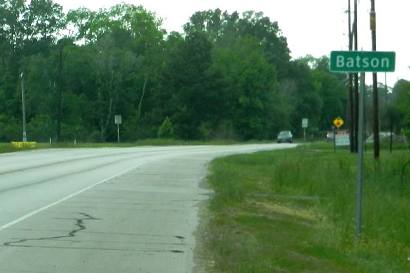
Batson,
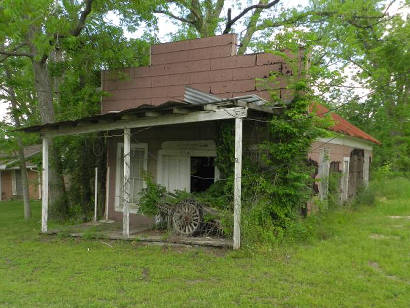
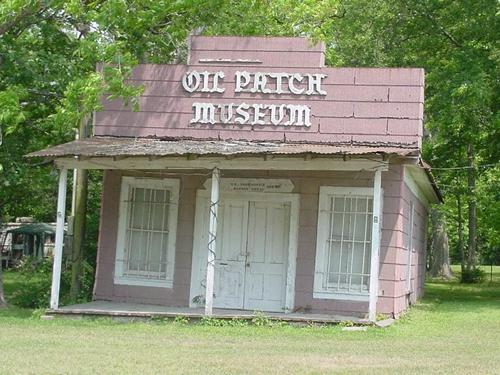
Texas former post office
Photo courtesy Barclay
Gibson, May 2013 |
History in
a 55-Gallon Drum
From 1891 to 1898, the town was known by the post office name Otto
after R. Otto Middlebrook - an early settler who probably did something
noteworthy to earn the honor, however our source was unable to provide
details.
The community had originally been settled before 1840 by the two Batson
Brothers. These two, as well as other residents, first lived in mud
houses (talk about humble origins) unaware that they were sitting
on top of millions of barrels of oil.
In October of 1903 the Batson-Oid field was discovered near Pine Bayou,
a mile north of Batson. Both town and post office moved to be closer
to the action - and action it was, with an estimated 10,000 workers,
camp-followers and innocent bystanders showing up to witness history-in-the-making
(and maybe make some money as well). The new town was named for Eli
Batson, a Batson Brother descendent.
Two schools were in operation in 1897 with total enrolment of 68 students.
Batson has all the businesses to guarantee success. Stores, a livery
stable, a blacksmith, four hotels and ten saloons made Batson a town
to be envied.
By 1906 Batson had three schools to educate the 252 children of oil
workers, and a bank. As oil production fell, so did the population.
It receded to a mere 600 in 1927. The New Batson field was discovered
in March 1935. The population rose to 1,000 by the 1930s. The population
was down to 200 from 1950 to 1970 and it has decreased further to
the current 140.
More on the Oil Field ›
Batson Images: |
 |
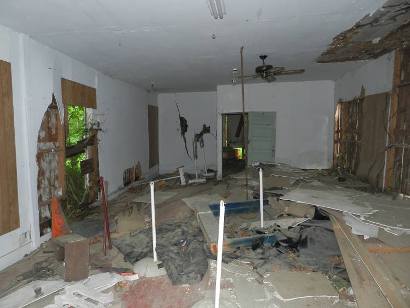
Former Post
Office/Oil Patch Museum interior today
Photo
courtesy Barclay
Gibson, May 2013 |
|
The former post
office once housed the Oil Patch Museum
"[I was told that the museum] has moved to a more modern structure
next to the Community Center." - Barclay
Gibson, June 1, 2013
TE Photo, November 2007
More Texas
Post Offices | Texas
Museums
|
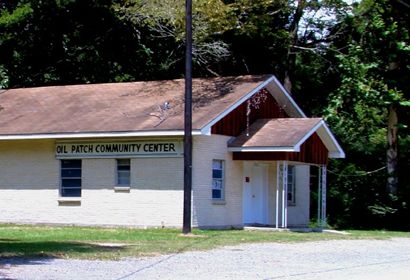
Oil Patch Community
Center
Photo
courtesy Ken
Rudine, August 2007 |
More on the
Oil Field
The discovery of
the Batson field was chronologically sandwiched between Spindletop
& Sour Lake (1901), and Humble
(1905). The four together established the first Gulf Coast oil fields.
The area had drawn attention as early as 1900 when "signs" of oil
were noticed. However a 1901 shallow exploratory well yielded nothing.
Two years later, inexperienced speculators S. W. Pipkin and W. L.
Douglas, organized an oil company financed by Beaumont
backers eager to find a new strike. On October 31, 1903 oil was found
at only 790 feet. Initial production was 600 barrels a day. Six weeks
later a second well brought in 4,000 barrels from a depth of 1,000
feet and a third well was soon producing 10,000 barrels daily. By
the end of 1903, Batson Field had an annual average of 4,518 barrels
of oil each and every day.
In January 1904 a new well brought in 18,000 barrels a day. Drilling
increased to a frenzy. Prior to 1930 no regulations existed to prevent
operators from sinking as many wells as they wanted - as close to
one another as they wanted. March 4, 1904, set a record when more
than 150,000 barrels of oil was brought up. The peak yearly production
was reached in 1904 when 10,904,737 barrels of oil were recovered.
In 1905 salt water started making its presence known and the field
started getting dry holes.1905 production fell to about one-third
of the 1904 figures.
Production declined for twenty years, however in 1924 deeper wells
reached oil at 3,600 feet. Production decreased by 1931 and continued
until November 1934. In 1935, annual production was back up to a respectable
616,474 barrels daily. In 1939, the Railroad Commission of Texas divided
the field into Batson Field and Batson-New field. At that time, the
old field reported 190 wells. At the end of 1948 the total number
of wells drilled in the field was 1,450.
The "lifestyle" of the early East
Texas fields have provided historians with some of the more colorful
anecdotes in Texas history.
No volume claiming to be a history of the oil industry is complete
without mentioning the hi-jinks and borderline depravity of the Saratoga-Batson-Sour
Lake fields. |
 |
Photographer's
Note:
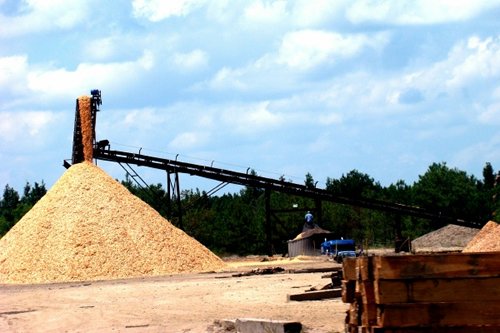
"Batson is an early oilpatch town with a now operating sawmill
denoting it is now in the lumbering business." - Ken
Rudine, August 26, 2007 |
| Texas
Escapes, in its purpose to preserve historic, endangered and vanishing
Texas, asks that anyone wishing to share their local history
and vintage/historic photos, please contact
us. |
|
|
 HOME
HOME
 Texas
Gulf Coast
Texas
Gulf Coast East
Texas
East
Texas Central
Texas North
Central
Texas North Central
Texas South
Central
Texas South Texas
Panhandle
Texas
Panhandle South
Texas
South
Texas Texas
Hill Country
Texas
Hill Country West
Texas
West
Texas Texas
Ghost Towns
Texas
Ghost Towns Texas
Counties
Texas
Counties