|
A
young man called, asking if I knew what a “dog trot house” was. He
had heard the phrase from one of his grandparents and had conjured
up visions of dogs trotting through a house day and night.
He wasn’t far from the mark.
Dog trot houses were built and occupied by East
Texas’ earliest settlers. Many of them migrated here in the early
l800s from the Old South and brought southern customs, including the
way buildings were constructed.with them.
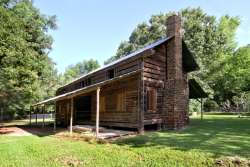
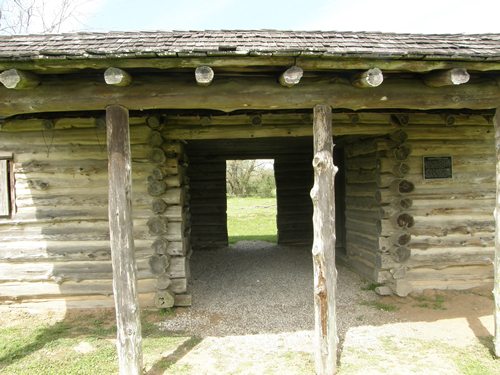
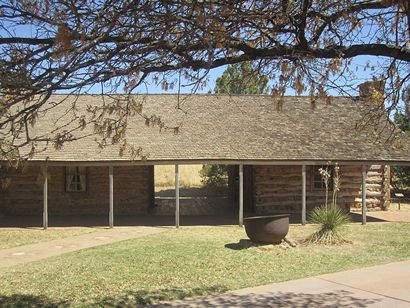
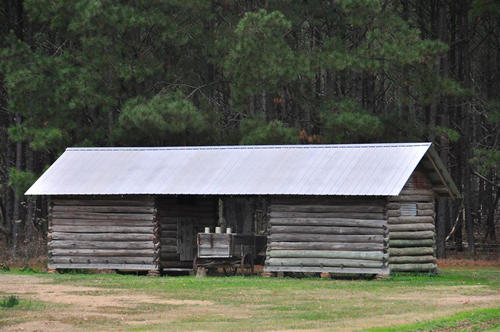
A dog trot house (also called a dog run house) was simple in construction.
Made either of logs or rough-sawn lumber, it consisted of two separate
living areas under one roof, but separated by a wide gallery that
divided the two family areas. One of the living areas consisted of
sleeping accommodations; the other was where the family cooked, ate
and entertained visitors.
There were no bathrooms or toilets in the building. Outhouses,
well separated from the house, met the family’s hygiene needs. Large
washtubs, filled with water from wells or springs, were used for baths.
The family’s dogs slept on the gallery and instead of running around
the house, they trotted from front to back by using the gallery.
The dog trot also served as a porch of sorts, but most houses had
a separate porch on the front of the house.
Few of the old-time dog trot homes are left in East
Texas. |
|
Ben
Anderson of Angelina
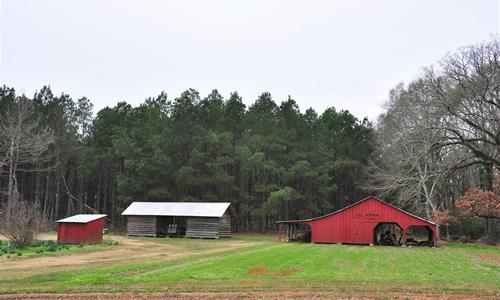
County called our attention to a well-preserved dog trot house
near Ratcliff
in Houston County.
It was a beauty to behold, framed by crepe myrtles and cedar trees.
It was built by a pioneer family in the Mount
Vernon community, where Henry Warren Payne and W.M. Conner gave
land for a church and a cemetery.
In 1871 a church house used as a school was erected. The custom
of fencing cemetery plots began in 1872 with the burial in the first
marked grave of the son of James E. and Ann Payne Ashby.
After a fire, Payne rode door-to-door raising money for a new church
house built in 1884. The Mt. Vernon Baptist Church was officially
organized in 1888. Land from the Louisiana and Texas Lumber Co.
enlarged the cemetery and in 1960 the church’s present building
was erected.
In
our family, my great-great grandfather, Joel Harrison Bowman, built
a dog trot house near Sardis in Cherokee
County, but the building rotted away after he died in 1936.
Doris’ grandparents, the Robert L. Davis family, also lived in a
dog trot house on Virgil Street in Lufkin,
but it, too, vanished as progress overtook Lufkin.
Other dog trot houses, fortunately, still stand elsewhere throughout
East Texas.
|
|
A two-story
log structure, was built by ferry owner James Gaines on the west
bank of the Sabine River
in the 1830s. When Toledo
Bend Reservoir was built, the old house was moved, and remains
an important landmark in
Sabine County.
Another dog trot, built before 1842, is known as the Trammel Trace
Cabin and is a recorded Texas historic landmark at Marshall,
where it was moved in 1938 by the Hobart Key family.
Dog trot houses are a unique part of our East
Texas heritage, and hopefully other buildings of the same style
are alive and well in the pineywoods.
© Bob
Bowman
Bob
Bowman's East Texas March
24, 2008 Column, modified 1-1-17
A weekly column syndicated in 109 East Texas newspapers
|
|
|
 HOME
HOME