|
History in
a Pecan Shell
by
Robin
Jett
Local author Martha Sue Stroud called Red
River County the "Gateway to Texas," which is a pretty apt description.
North of Clarksville
lies Jonesboro, the site of a prominent ferry crossing and steamboat
port. The town, which had a hotel, a blacksmith shop, and several
warehouses, developed in 1816 and served as the Miller County, Arkansas
seat for a while. Famous men like Sam
Houston, Davy Crockett, Benjamin
Milam and Stephen
F. Austin entered the state here, where they then picked up the
Trammel's Trace (the
northern road to Nacodogches) -
maybe to find more action? In any case, county historians like to
argue that Jonesboro should be considered the first permanent settlement
of Anglo-Americans in New Spain. Unfortunately for them, state historians
dismiss its importance because Jonesboro wasn't considered a legal
part of Texas until 1836, and still give Stephen
F. Austin's colony the nod. Those sticklers.
Poor Jonesboro, wiped out by a flash flood in the 1840s, is not even
a ghost town anymore. Only an old tombstone reminds one of what used
to be there.
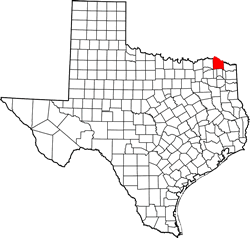
The site is now a roadside park on FM 410, near Kiomatia,
Red
River County.
© Robin
Jett July 2003
Robin
Jett publishes Red River Historian, a newsletter about
the history of the Red River Valley - both Texas and Oklahoma. She
can be reached at robin@redriverhistorian.com |
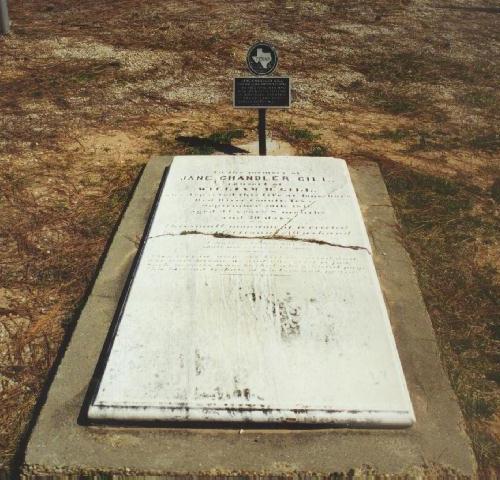 |
Jonesboro Grave:
This tombstone is the only original remnant of Jonesboro. A farmer
found it in his field nearby as he was plowing. It commemorates
Jane Chandler Gill, an English woman who died in 1846, shortly after
making the Red River crossing.
Photo courtesy Robin
Jett, July 2003
|
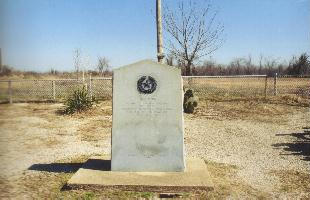
Jonesboro Marker
at the Jonesboro roadside park reminds the reader that "Near Here
at the old Jonesboro Crossing Sam
Houston an envoy of President Andrew Jackson first set foot on
Texas soil December 2, 1832."
Photo
courtesy Robin
Jett, July 2003 |
Texas
Centennial Marker
(Located in Sam Houston Park, CR 2381, 0.2 miles SE of CR 2353):
Jonesboro
(About a half mile
NW was 19th century town)
One of first ports of entry into Texas for Anglo-Americans.
Opened early as 1814;
heavily used by 1817.
Named for 1819-21 ferry owner Henry Jones (1789-1861).
Claimed by both Mexico and the United States, town was 1828-37 county
seat of Miller County, Ark.
Community had 2,350 people by 1834. At this crossing Sam
Houston (1832) and David Crockett (1835) entered Texas. A well-known
road led southeastward to other colonies by way of Nacogdoches.
In 1836, Clarksville
became Red River District's capital. By 1840 Jonesboro had lots its
trade and many settlers to other areas. |
| Texas
Escapes, in its purpose to preserve historic, endangered and vanishing
Texas, asks that anyone wishing to share their local history, stories,
landmarks and recent or vintage photos, please contact
us. |
|
|
 HOME
HOME